On This Page
OBC Certificate Online 2026: Rs 8 L Limit, Non-Creamy Layer
Get OBC-NCL certificate from Tehsildar/SDM office, income limit ₹8 lakh/year, valid 1 financial year for central govt jobs & UPSC. Apply online at your state portal or offline at district office.

Updated May 2026
Need a 50KB photo for this form?
Resize your photo and signature to the exact size any form needs. Free, instant, and your photo never leaves your phone.
⚠️OBC vs OBC-NCL, Critical Difference You Must Know
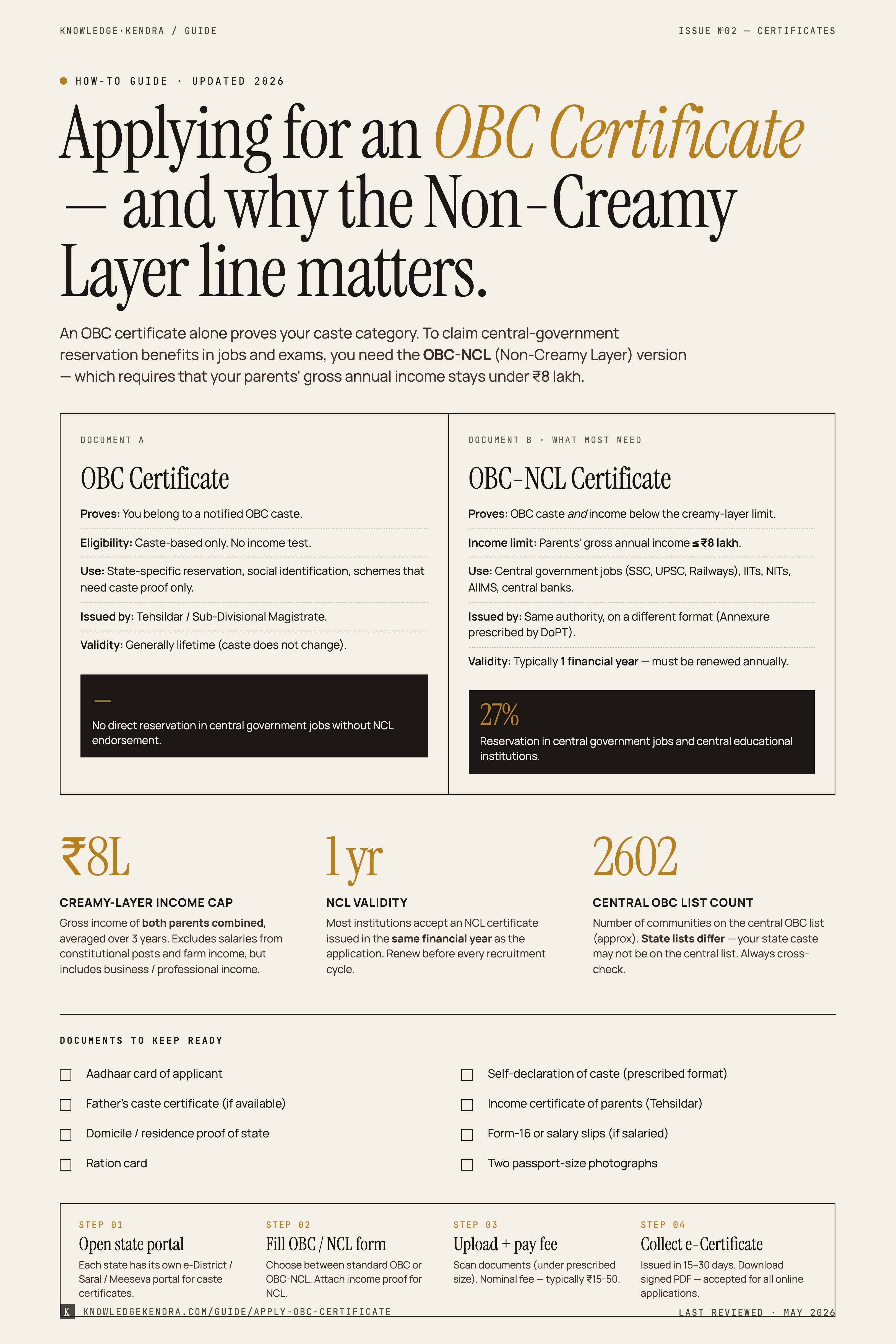
An OBC certificate alone is not enough for central government jobs. This is the single most common mistake applicants make.
For central jobs and institutions like UPSC, IIT, NIT, and AIIMS you need two certificates. One is the OBC caste certificate, the other is the Non-Creamy Layer, or NCL, certificate.
The OBC certificate confirms your caste is on the central OBC list maintained by the NCBC. It is issued by the SDM or Tehsildar and is valid for life.
The NCL certificate confirms your family is not in the creamy layer. That means neither parent held a Group A or B post for 10 or more years, and family income from non-agricultural, non-salary sources stays below ₹8 lakh a year.
The NCL certificate is valid for one year and must be renewed. It answers whether your family is below the income threshold and not holding senior government posts.
The two-certificate rule exists to keep reservation with the genuinely backward. A wealthy OBC family in the creamy layer is not meant to claim the quota.
For any central government job like UPSC, SSC, IBPS, Railways, or a PSU, you need OBC-NCL, not plain OBC.
This is the number-one mistake students make. OBC-NCL checks both your caste and family income below ₹8 lakh a year.
OBC Caste Certificate vs OBC-NCL Certificate
✅Who Qualifies for OBC-NCL Reservation (Central Government)
How to Apply for OBC-NCL Certificate
🖥️ Applying online, explained simply
Start at your state e-District portal and search for the OBC or non-creamy-layer service. The label varies, so also try caste or reservation certificate.
Register with your mobile number and Aadhaar, then log in. Aadhaar linkage speeds up the verification stage.
Fill the form with your caste, your parents' occupation, and family income from non-salary sources. Be precise about the income source, since salary and farm income are treated separately.
Upload Aadhaar, caste proof, and income proof for the three preceding years. Keep each scan within the size limit the portal shows.
Submit and save the acknowledgement number. It is how you track the file and download the certificate once approved.
After submission a local officer verifies your income and caste details. This field check is why the process takes two to four weeks.
You can track each stage on the portal using your acknowledgement number. A file stuck at verification for over three weeks is worth a visit or a written follow-up.
💰Understanding the ₹8 Lakh Income Limit, What Counts & What Doesn't
| Income Source | Counted Toward ₹8L Limit? | Notes |
|---|---|---|
| Salary (from job) | NOT counted (usually) | Recent DoPT clarification: salary income alone doesn't make you creamy layer |
| Agriculture income | NOT counted | Agricultural activities explicitly excluded from creamy layer calculation |
| Business income | COUNTED | Profits from self-owned business, shop, factory count toward ₹8L limit |
| Professional income (doctor, lawyer, CA) | COUNTED | Income from profession counts toward limit |
| Rental income (from property/shop) | COUNTED | Rent from land/property/building counts |
| Interest/dividend income | COUNTED | Passive income from investments counts |
| Pension | NOT counted clearly (varies) | Some states exclude pension, others count it. Check state-specific rules. |
| Spouse's income | NOT counted | Spouse's income is separate, not included in parents' income calculation |
🚫What 'Creamy Layer' Means, Complete Breakdown
You ARE in creamy layer (ineligible for OBC-NCL reservation at central level) if:
1. Either of your parents holds/held Group A or Group B central government post (like IAS, IPS, deputy collector, police commissioner, principal of government college) for 10 or more continuous years.
Example: Father was a collector for 12 years, you're creamy layer even if family income is ₹5L.
2. Either of your parents held Group A/B post and are now retired, AND their retirement was within 10 years of your NCL application.
Example: Father retired as DIG in 2023, and you're applying for NCL in 2026 (3 years after retirement), still creamy layer because within 10 years of retirement.
3. Your family's annual income from non-agricultural, non-salary sources exceeds ₹8 lakh for 3 consecutive years before your application.
Example: Father's business profit is ₹10L/year, family is creamy layer.
You are NOT in creamy layer (eligible for OBC-NCL) if:
1. Your father was never in Group A/B government service (or was only in Group C/D positions like constable, clerk, peon).
2. If father was in Group A/B, he retired more than 10 years ago.
3. Family income from non-salary, non-agricultural sources is less than ₹8 lakh/year.
4. Salary income (even if ₹50L+) doesn't make you creamy layer under current DoPT interpretation.
📅 The three-year income rule most people miss
The ₹8 lakh limit is not judged on a single year. Your family income must stay below it in each of the three financial years before you apply.
Even one year over the limit disqualifies you. A family at ₹6 lakh, ₹7 lakh, and ₹9 lakh across three years is treated as creamy layer.
This trips up families with a one-off spike, like a property sale or a bonus year. The office looks back three years, not just the latest.
Keep income proof for all three years ready. An ITR or income certificate for each year makes verification faster and cleaner.
The three-year window is counted backward from the year of application, not the calendar year. Read the notification carefully, since it fixes which years are checked.
If a single year was high due to a one-time event, keep documents explaining it. Some offices accept a clear explanation with proof, though the rule is applied strictly.
Annual family income limit (Non-Creamy Layer)
Applies to non-agricultural income only. Agricultural income is excluded. Parents in Group-A or equivalent central/state government posts cause automatic creamy layer disqualification regardless of income level.
What Counts in the Rs 8 Lakh Income Calculation
📍OBC List Variants, Central vs State
The central OBC list is maintained by the NCBC. If your caste is on it, you qualify for 27% reservation in central jobs, central institutions, and central PSUs.
Each state also maintains its own OBC list. Some castes appear on a state list but not on the central list.
A caste recognised as OBC in Maharashtra may not be on the central list. In that case you get OBC benefit for state jobs and state universities only, not for central jobs.
Always verify your caste on the central list at ncbc.nic.in before applying. If it is not there, an OBC-NCL certificate will not help for UPSC or other central jobs.
You can still get a state OBC certificate for state jobs. So a caste listed as OBC in Rajasthan but not centrally can claim reservation for Rajasthan Police, but not for UPSC.
Are You Eligible for OBC-NCL Certificate?
- Your caste is on the Central OBC list (ncbc.nic.in)
- Family annual income below Rs 8 lakh (non-agri)
- Neither parent holds Group A government post
- Father is not Constitutional post holder (MP/MLA/Judge)
- Family does not own large agricultural land (state-specific limits)
- All income documents available and current
- Caste not on Central OBC list (different from State list)
- Family income above Rs 8 lakh non-agricultural
- Father/Mother is Group A officer (IAS/IPS/IRS etc.)
- Parent holds Constitutional post
- Family classified as Creamy Layer in previous year
- Trying to use State OBC cert for Central jobs (rejected)
❓Special Cases & Income Interpretation
The standard process works for most applicants. A few situations need extra documents or a different approach.
Interstate migration: your OBC status follows the state where your family originally belongs, not where you now live. Claiming OBC in a new state where your caste is not listed will fail.
Inter-caste marriage: a woman generally retains her birth caste for reservation, not her husband's. The certificate is issued on the father's side, so carry his caste proof.
Adopted or single-parent families: the caste follows the biological or adoptive father's community as recorded. Bring the relevant caste and family records.
Government-employee parents: whether you are creamy layer depends on the parent's post rank and years since promotion or retirement, not just pay. State the exact post and dates clearly.
🔄OBC-NCL Certificate Renewal, Annual Update
The OBC-NCL certificate is valid for one financial year and must be renewed. This is different from the permanent OBC caste certificate.
A certificate issued in January 2026 for FY 2024-25 is valid until 31 March 2026. From 1 April 2026 you need a fresh one for FY 2025-26.
For exams, the certificate must be valid on the notification or closing date. A UPSC 2026 notification in February needs a certificate issued after 1 April 2025.
An older certificate from before April 2025 is treated as expired and rejected. This catches many candidates at document verification.
Apply for renewal in March, before the financial year ends. Processing takes 15 to 30 days, so a new certificate by May covers the recruitment season.
Renew on your state portal with updated income proof like the current ITR or income certificate. Renewals are usually faster than a first application.
Check your caste on the central list at ncbc.nic.in, and read creamy-layer rules at dopt.gov.in.
Apply on your state portal: UP edistrict.up.gov.in, Bihar serviceonline.bihar.gov.in, MP mpedistrict.gov.in. Always use the official portal, not agents.
OBC-NCL Certificate Process Timeline
Top reasons: (1) Using a State OBC certificate for Central job applications (different lists), (2) Income certificate older than 6 months at submission, (3) Income includes agricultural income wrongly, (4) Name mismatch across Aadhaar, caste, income certificates, (5) Parent's government job not properly disclosed. Fix the specific reason in your rejection letter and reapply with correct documents.
Source: National Commission for Backward Classes and DoPT creamy-layer memorandums.
This page is verified against official notifications. Always check the official portal for the latest rules before applying.
🗺️State-Wise OBC Certificate: What Differs Across States
OBC rules are not uniform across India. Each state has its own list, portal, validity, and sometimes its own income limits for state reservation.
Uttar Pradesh applies through edistrict.up.gov.in with 1-year validity. Its state list overlaps the central list but adds some castes excluded centrally.
Maharashtra applies through Aaple Sarkar with 3-year validity, the most generous. It also runs a parallel SEBC reservation for state jobs alongside OBC for central jobs.
Karnataka applies through Seva Sindhu with 1-year validity. It uses category 1, 2A, 2B, 3A, and 3B sub-groups that map to the central list.
Tamil Nadu applies through e-Sevai and runs a separate MBC reservation alongside OBC. For central jobs there, applicants still need the central OBC-NCL certificate.
Bihar and Rajasthan both use 1-year validity. Bihar applies through RTPS, Rajasthan through e-Mitra, and both want income proof current within 6 months.
👥OBC Certificate for Special Cases
Standard OBC certificate process works for most applicants, but special categories require additional documentation or different procedures. Five most common special cases:
Special Cases: Documentation Differences
💡When in Doubt, Get a Lawyer's Opinion
Special-case applications are far more likely to face rejection than standard ones. A wrong assumption creates a formal rejection record that makes reapplying harder.
For complex cases like interstate migration, inter-caste marriage, or promotion-related creamy-layer doubt, a local lawyer who handles these costs ₹500 to ₹2000. That is cheaper than months of confusion.
Keep a family caste-history file with grandparents' and parents' caste records. This backup strengthens disputed claims and helps during renewal disputes.
OBC-NCL vs Other Reservation Categories: Which Applies to You?
The OBC certificate with non-creamy layer is not just about reservation, it opens doors to fee concessions, age relaxation in competitive exams, and dedicated scholarship schemes that can fund an entire education.
📄 What a valid OBC-NCL certificate must show
A central OBC-NCL certificate must name the caste and confirm it is on the central OBC list. It must state the family does not fall in the creamy layer.
It should mention the financial year it covers and be signed by a competent authority like the SDM, DM, or Tehsildar. Missing any of these is a common rejection reason.
For central jobs, use the central prescribed format, not a plain state OBC certificate. Many recruiters name the exact format in the notification.
The form and format are available on your state e-District portal. Use the current official version rather than an old downloaded copy, since fields change.
A certificate missing the financial year is often rejected outright. Recruiters read that year to confirm it is current, so it cannot be blank.
The issuing authority's designation matters as much as the signature. A certificate from a village-level officer instead of the SDM or Tehsildar can fail verification.
🗂️ Documents and what each proves
🎯 Why the non-creamy-layer certificate matters
The NCL certificate is what actually unlocks the 27% OBC quota in central jobs and colleges. A plain OBC certificate on its own does not.
It also brings age relaxation and extra attempts in exams like the UPSC civil services. These benefits ride on holding a valid NCL certificate.
Because it expires each financial year, a lapsed certificate quietly blocks every one of those benefits. Aspirants lose seats at document verification for exactly this reason.
Keeping a current-year certificate ready before notifications open is the safest habit. It protects reservation, age relaxation, and attempt benefits together.
For SSC, banking, and railway exams the same rule applies as UPSC. Each wants a certificate valid for the year of the notification.
State jobs may accept a plain state OBC certificate without the NCL layer. Always separate the central requirement from the state one before you apply.
The fee is small or free on most state portals, so avoid agents who charge extra. Apply directly to keep control of your documents.
Renew every year in March, before the financial year ends. A certificate ready by May covers the whole recruitment season.
✅ A quick check before you apply
Confirm your caste is on the correct list first. Use the central list at ncbc.nic.in for central jobs, and your state list for state jobs.
Gather income proof for the three preceding years, not just the latest one. This is the single biggest cause of avoidable rejection.
Decide whether you need the central format or the state format. Match it to the exact wording in the recruitment notification.
Apply early enough that the certificate covers the notification date. A fresh certificate from the current financial year avoids last-minute panic.
📌 You might also need
Not sure if you qualify?
Check your eligibility for 50+ government schemes in 2 minutes. No login, no fees. Just answer a few simple questions.
❓Frequently Asked Questions
📋 Official Sources & Verification
Information verified against official government portals and gazette notifications. Read our editorial process.
May 2026