Demat Account 2026: Open Online, Charges & Best Brokers: Everything about opening and using a demat account in India - online process, charges breakdown, broker comparison, BSDA accounts for small investors, and answers to 25+ common questions..Opening Fee: ₹0 (Most Brokers). AMC: ₹0-300/Year. Setup Time: 15 Minutes. Documents: PAN + Aadhaar.
On This Page
💰 DEMAT ACCOUNTUpdated May 2026
Demat Account 2026: Open Online, Charges & Best Brokers
Everything about opening and using a demat account in India - online process, charges breakdown, broker comparison, BSDA accounts for small investors, and answers to 25+ common questions.

Ash K.
Updated May 2026
Updated May 2026
AMC
₹0-300/Year
Setup Time
15 Minutes
Documents
PAN + Aadhaar
📖💡 What is a demat account?
A demat account holds your shares and other investments in electronic form, the way a bank account holds your money. Demat is short for dematerialised, meaning paper certificates turned into digital records.
Before demat accounts, shares were physical paper that could tear, get lost, or be forged. Now they sit safely as electronic entries against your name.
When you buy a share, it lands in your demat account. When you sell, it leaves from there.
You never handle paper at all. The whole process is digital from start to finish.
It is the foundation of stock investing in India. Without one, you cannot buy or hold listed shares.
🔒 Your shares are not held by the broker
💡🔒 Your shares are not held by the broker
A demat account holds your securities, not your money. Cash stays in your bank until you buy.
This is why your shares are safe even if your broker shuts down, they sit at NSDL or CDSL, not with the broker.
💰📊 Demat charges at a glance
₹0 (most brokers)
Account opening
₹0-₹300
AMC per year
₹0 at discount brokers
Delivery brokerage
₹13.5-₹20
DP charge per sell
🔀⚖️ Demat vs trading vs bank account
These three accounts work together but do different jobs. Mixing them up is the most common beginner confusion.
Your bank account holds money. Your trading account is the place where you place buy and sell orders.
Your demat account holds the shares themselves after a purchase. Money moves from bank to trading to buy, and shares land in demat.
Most brokers open the trading and demat account together. So in practice you deal with one login, even though three accounts are involved.
🔄🏦 How a trade flows through your accounts
1
Place order (trading account)
You tap buy or sell in your broker app, which routes the order to the NSE or BSE.
2
Money moves (bank account)
Funds move from your linked bank account to the exchange for a buy, or proceeds come back on a sell.
3
Shares settle (demat account)
Shares are credited to your demat on T+1, one business day after the trade. They stay there until you sell.
📋🗂️ Types of Demat Accounts in India
| Type | Who Can Open | Key Features |
|---|---|---|
| Regular Demat | Resident Indians | Standard account for residents. Hold any securities. Most common type. |
| Repatriable Demat (NRI) | NRIs with NRE bank account | Allows transfer of funds abroad. Linked to NRE account. Requires FEMA compliance. |
| Non-Repatriable Demat (NRI) | NRIs with NRO bank account | Cannot transfer funds abroad. Linked to NRO account. Lower compliance burden. |
| Basic Services Demat (BSDA) | Small investors (holdings up to ₹10 lakh) | Nil AMC up to ₹4 lakh, ₹100/year for ₹4-10 lakh. From 31 March 2026, opened by default unless you opt out. |
| HUF Demat | Hindu Undivided Family | Held in name of HUF karta. Separate PAN required. Used for tax planning. |
| Corporate Demat | Companies, partnerships | Higher documentation. Used by businesses for treasury investments. |
🏛️⚖️ NSDL vs CDSL: which depository?
India has two depositories that actually store your shares: NSDL and CDSL. Your broker is linked to one of them.
For you as an investor, the choice barely matters. Both are safe, SEBI-regulated, and hold shares identically.
The difference shows only in your demat number format. NSDL numbers start differently from CDSL ones, but the experience is the same.
You do not pick the depository yourself. Your broker decides, and either one is perfectly fine.
💰💡 Demat account charges explained
A demat account is rarely truly free, even when opening costs nothing. A few small charges are worth knowing upfront.
Opening is usually free with most discount brokers now. The annual maintenance charge, or AMC, ranges from zero to a few hundred rupees a year.
The one that surprises people is the DP charge. It is a small flat fee the depository takes each time you sell shares, regardless of the amount.
Brokerage is separate and depends on your broker. Discount brokers charge little or nothing on delivery trades, while full-service ones charge more.
💰 Watch the DP charge
💡💰 Watch the DP charge
DP charges of ₹13.5-20 apply per sell transaction, not per share.
Selling 5 different stocks triggers 5 separate charges, which adds up fast for frequent traders.
⚖️⚖️ Top 10 Demat Brokers Compared - 2026
| Broker | Opening | AMC/Year | Delivery | Intraday/F&O | Best For |
|---|---|---|---|---|---|
| Zerodha | ₹0 | ₹300 | ₹0 (Free) | ₹20/order | Largest broker, active traders, best charting |
| Groww | ₹0 | ₹0 | ₹20/order | ₹20/order | Absolute beginners, mutual funds + stocks |
| Angel One | ₹0 | ₹0 | ₹0 (Free) | ₹20/order | Free delivery + research reports |
| Upstox | ₹0 | ₹300 | ₹20/order | ₹20/order | Fast execution, Ratan Tata-backed |
| 5Paisa | ₹0 | ₹300 | ₹20/order | ₹20/order | Low-cost, IIFL-backed, mobile-first |
| Dhan | ₹0 | ₹0 | ₹0 (Free) | ₹20/order | Active traders, advanced features |
| Paytm Money | ₹0 | ₹0 | ₹0 (Free) | ₹20/order | Paytm users, integrated experience |
| ICICI Direct | ₹0 | ₹700 | 0.29% | 0.029% | ICICI Bank customers, 3-in-1 account |
| HDFC Securities | ₹999 | ₹750 | 0.32% | 0.032% | HDFC customers, research reports |
| Kotak Securities | ₹0 | ₹600 | 0.25% | 0.025% | Kotak customers, full-service broker |
🧾💰 Zerodha charges, official pricing
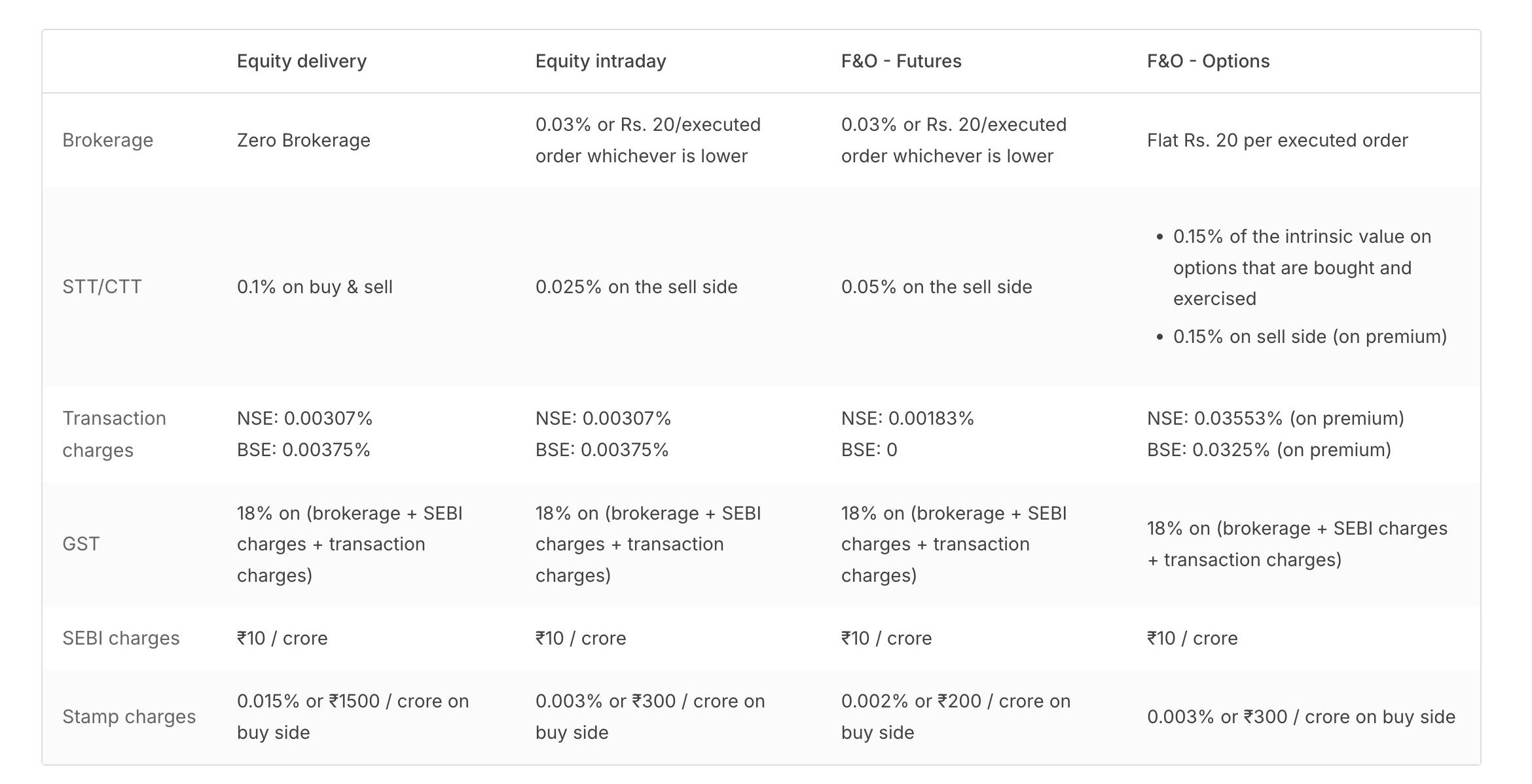
🏆 Which broker to pick
💡🏆 Which broker to pick
For absolute beginners: Groww or Angel One, simplest interface and zero AMC.
For active traders: Zerodha, best execution and charting. For a bank-linked 3-in-1 account: ICICI Direct if you already bank there.
🎁💰 BSDA: the low-cost account for small investors
The Basic Services Demat Account, or BSDA, is a SEBI scheme for small investors. SEBI raised the limits in September 2024, so far more people now qualify.
There is nil AMC if your holdings stay up to ₹4 lakh. For holdings between ₹4 lakh and ₹10 lakh, the AMC is capped at ₹100 a year plus GST.
Above ₹10 lakh, the account moves to a regular demat with standard charges. You can have only one BSDA, and you must be its sole or first holder.
Many accounts are now auto-converted to BSDA if they qualify. If your portfolio is small, this quietly saves you the regular maintenance fee.
📊💰 BSDA AMC slabs (2026)
| Holdings value | Annual maintenance charge |
|---|---|
| Up to ₹4 lakh | Nil (free) |
| ₹4 lakh to ₹10 lakh | ₹100 per year (max) |
| Above ₹10 lakh | Converts to regular demat, standard AMC |
📄🚀 Documents Required to Open a Demat Account
| Document | Status | Purpose |
|---|---|---|
| PAN Card | Mandatory | Tax identification, KYC |
| Aadhaar Card (linked to mobile) | Mandatory | Identity verification via OTP, e-KYC |
| Bank Account Details | Mandatory | For fund transfers, IFSC + account number |
| Cancelled Cheque or Bank Statement | Mandatory | Bank account verification |
| Passport-size Photo | Mandatory | Account records |
| Signature on Plain Paper | Mandatory | Digital signature upload |
| Selfie with PAN | Mandatory | Live verification (video KYC) |
| Income Proof (salary slip/ITR) | Mandatory for F&O | Required only for derivatives trading |
| Address Proof (if Aadhaar address differs) | Conditional | Only if current address differs from Aadhaar |
🚀🚀 How to Open a Demat Account Online - Step by Step
1
Choose a broker and download the app
For beginners: Groww or Angel One (simplest interface, great for learning). For active traders: Zerodha or Upstox (best charting tools). For bank-integrated experience: ICICI Direct or HDFC Securities. Compare account opening fees, AMC, and brokerage before deciding.
2
Start online application with PAN and mobile
Enter your PAN number, full name, and mobile number. You'll receive OTPs for verification on both. Ensure PAN is not linked to an existing demat account with the same broker - you cannot open duplicate accounts with one broker.
3
Complete e-KYC with Aadhaar
Enter your 12-digit Aadhaar number and verify with OTP sent to your Aadhaar-linked mobile. Your name, date of birth, and address are auto-fetched from UIDAI database. If Aadhaar is not linked to mobile, you must visit a branch for physical KYC.
4
Take selfie and digital signature
Use your phone's camera for a clear selfie (good lighting, straight face, no glasses recommended). For digital signature, sign on plain white paper with black pen, photograph it, and upload. Some brokers require a short video recording for in-person verification (IPV) as per SEBI rules.
5
Link bank account details
Provide your savings account number and IFSC code. Some brokers verify with a ₹1 test transaction from your account. Ensure the bank account is in your name only - joint accounts with spouse may cause issues unless you're the primary holder.
6
Choose trading segments and complete
Select what you want to trade: Equity Cash (stocks), F&O (derivatives - requires income proof), Commodity, Currency. For beginners, start with Equity Cash only. Confirm all details and e-sign with Aadhaar OTP to submit.
7
Receive credentials in 24-48 hours
Demat account number (starts with IN for NSDL or 16-digit for CDSL) + trading login ID + DP ID delivered via email and SMS. Most discount brokers activate accounts within 4-6 hours. Bank brokers may take 2-3 days.
8
Add money and start trading
Transfer funds from linked bank account to trading account via NEFT/UPI/IMPS. Search for a stock (e.g., RELIANCE), enter quantity, check order details (market vs limit, delivery vs intraday), and execute. Shares appear in your demat account on T+1 (one business day).
📅 T+1 settlement: when shares reach you
💡📅 T+1 settlement: when shares reach you
India uses T+1 settlement. If you buy today (T), shares are credited to your demat the next business day (T+1).
For a sale, the money reaches your account on T+1 too. This is among the fastest settlement cycles in the world.
🧾🧾 Taxes on your stock market gains
Profits from shares are taxed based on how long you held them. The line is one year for listed shares.
Sell within a year and the gain is short-term, taxed at a flat rate. Hold beyond a year and it is long-term, taxed at a lower rate with an annual exemption.
Dividends are taxed in your hands at your slab rate. The company no longer pays dividend distribution tax on your behalf.
Keep your contract notes and statements. At filing time, your gains and the tax already deducted both need to be reported.
📊💼 Do you need a demat account for mutual funds?
For most mutual funds, you do not need a demat account at all. You can buy them directly from the fund house or through apps in regular folio form.
A demat account is optional for mutual funds, not required. Many investors hold funds without ever opening one.
The exception is ETFs, which are exchange-traded and do need a demat account. So if you want ETFs, the demat account becomes necessary.
For a plain SIP in a mutual fund scheme, skip the demat requirement. It only matters once you move into shares or ETFs.
🔒🔒 Is your money safe if the broker shuts down?
This worry stops many beginners, but the structure is reassuring. Your shares do not actually sit with the broker.
They are held by the depository, NSDL or CDSL, against your name. The broker is only a middleman who connects you to them.
So if a broker shuts down, your shares remain safe at the depository. You can transfer them to another broker and carry on.
Money in the trading account is different, so do not leave large idle cash with a broker. Keep spare funds in your bank, and move them only when investing.
💰 Is a demat account free?
💡💰 Is a demat account free?
Opening is free at most discount brokers, and AMC can be ₹0 (Groww, Angel One) or up to about ₹300.
Small investors pay nil AMC under BSDA up to ₹4 lakh. You only pay when you actually trade or sell.
⚠️🚀 Common Problems & How to Solve Them
| Problem | Solution |
|---|---|
| Shares not credited after purchase | Wait for T+1 settlement day. If still missing, raise ticket with broker. Shares legally must be credited by T+2. |
| Negative balance showing in demat | Usually a DP charges pending. Pay outstanding amount via trading account. Contact broker if amount looks incorrect. |
| Can't sell inherited shares | Complete transmission from deceased holder. Required: death certificate, succession certificate/will, KYC documents. Process takes 4-6 weeks. |
| Demat account frozen by broker | Usually due to unpaid AMC or inactive account (no activity for 12 months). Pay dues, complete re-KYC, submit reactivation form. |
| Wrong shares in my demat | Rare but possible during corporate actions (bonus, split). Raise complaint with broker immediately. SEBI SCORES platform escalates if unresolved in 30 days. |
| Transfer demat to another broker | Submit DIS (Delivery Instruction Slip) to current broker requesting transfer to new DP. Takes 7-14 days. Some brokers charge ₹25-50 per transfer. |
| Close demat account | Submit account closure form to broker. Shares must be sold or transferred first. AMC is prorated. Broker must close within 7 working days. |
💤🏦 Dormant Demat Account: What It Means
If you do not use your demat account for a long stretch, it can be marked dormant or inactive. This is common and easy to fix.
A dormant account is simply one with no activity for an extended period. Your shares stay safe; the account is just frozen for new transactions.
To reactivate it, contact your broker and complete a fresh KYC or reactivation form. They may ask for updated documents.
It is worth logging in occasionally even if you are not trading. A quick check keeps the account active and your details current.
🔢🚀 How to Find Your Demat Account Number
Your demat account number is on every statement your broker sends. It is also visible inside your broker app under account details.
If you have lost track of it, the easiest route is the Consolidated Account Statement. NSDL and CDSL both let you pull this using your PAN.
The number looks different depending on the depository. A CDSL number is a 16-digit figure, while an NSDL one is split into a DP ID and a client ID.
You can also call your broker's support with your PAN and registered details. They will read out or email your demat number after verification.
👪👤 Add a nominee, it is now required
👪👤 Add a nominee, it is now required
SEBI requires demat account holders to either add a nominee or formally opt out. Skipping it can get the account frozen for transactions.
Adding a nominee is free and takes a few minutes online. It ensures your shares pass smoothly to the right person without legal hassle.
📚📚 Official Sources & Further Reading
| Resource | What It Covers | Official Link |
|---|---|---|
| SEBI - Demat Regulations | All regulatory framework for demat accounts, broker licensing, grievance redressal | sebi.gov.in |
| NSDL - Investor Services | Check demat account status, download holdings statement, e-CAS (Consolidated Account Statement) | nsdl.co.in |
| CDSL - Easi/Easiest | Access demat holdings online, transfer shares between DPs, e-voting for company AGMs | cdslindia.com |
| SEBI SCORES Portal | File complaints against brokers/DPs, track grievance resolution within 30 days | scores.sebi.gov.in |
| IT Dept - Capital Gains | File ITR, check STCG/LTCG rates, pre-filled ITR forms with broker data | incometax.gov.in |
| Investor Awareness (SEBI) | Verified educational content, investor protection fund claims, fraud alerts | investor.sebi.gov.in |
📖📚 Official Sources & References
📖📚 Official Sources & References
Source: SEBI Depositories Act 1996, plus CDSL and NSDL guidelines.
All figures are verified against official notifications. Charges and rules change, so confirm on the official portal before acting.

Share this infographic
❓Common Questions
🔗Related Topics
Investing
What is SIP?
InvestingWhat is Mutual Fund?
CompareMutual Fund vs FD
CompareSIP vs Lumpsum
CompareSIP vs FD vs PPF
InvestingWhat is ELSS?
📋 Official Sources & Verification
Information verified against official government portals and gazette notifications. Read our editorial process.
Researched & verified from official sources
Last reviewed
May 2026
May 2026