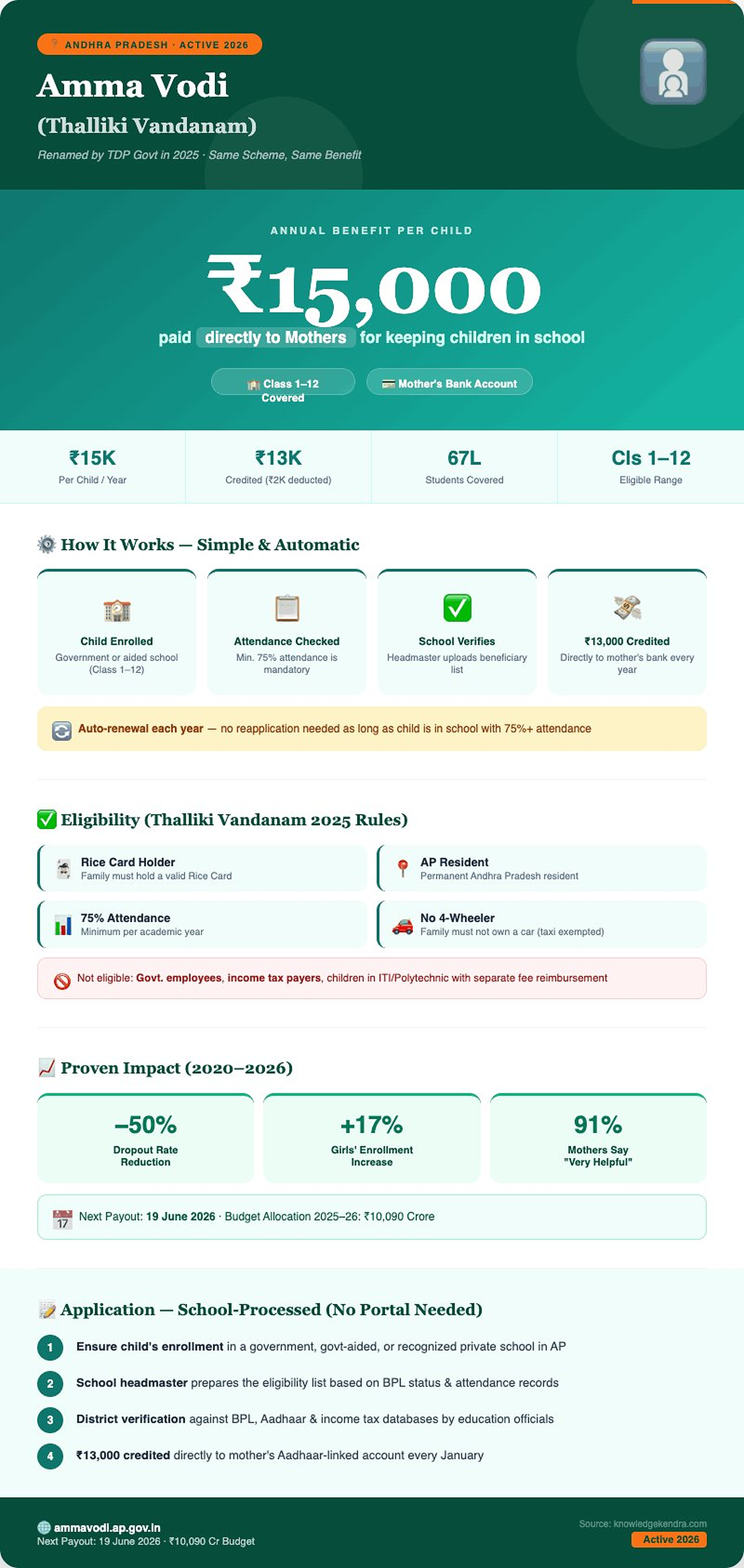
Amma Vodi 2026: Now Thalliki Vandanam, Rs 15,000/Year AP: Andhra Pradesh's mother-incentive scheme. Renamed Thalliki Vandanam in 2025 under TDP government. Rs 15,000/year transferred to mothers of school-going kids (Rs 13,000 credited after Rs 2,000 school development deduction)..Annual Benefit: Rs 15,000/child. Credited Amount: Rs 13,000 (Rs 2K deducted). Beneficiaries: 67 Lakh Students. 2026-27 Payment: Released July 2026.Amma Vodi - meaning 'Mother's Gift' - is Andhra Pradesh's revolutionary scheme addressing a persistent education challenge: dropout. Rather than paying students (traditional scholarship model), Amma Vodi pays mothers ₹15,000 annually for keeping their children in school.
On This Page
Active SchemeUpdated: July 2026
👩👧
Amma Vodi 2026: Now Thalliki Vandanam, Rs 15,000/Year AP
Andhra Pradesh's mother-incentive scheme. Renamed Thalliki Vandanam in 2025 under TDP government. Rs 15,000/year transferred to mothers of school-going kids (Rs 13,000 credited after Rs 2,000 school development deduction).
Annual Benefit
Rs 15,000/child
Credited Amount
Rs 13,000 (Rs 2K deducted)
Beneficiaries
67 Lakh Students
2026-27 Payment
Released July 2026
📖What is Amma Vodi 2026: Now Thalliki Vandanam, Rs 15,000/Year AP?
Amma Vodi - meaning 'Mother's Gift' - is Andhra Pradesh's revolutionary scheme addressing a persistent education challenge: dropout. Rather than paying students (traditional scholarship model), Amma Vodi pays mothers ₹15,000 annually for keeping their children in school.
This approach recognizes that in many low-income families, the decision to withdraw children from school is made by parents, not children, often due to household economic pressures. By incentivizing mothers - traditionally the household member most invested in children's welfare - the scheme directly impacts enrollment and retention.
Launched as part of Jagananna (chief minister's welfare program) in 2020-21, Amma Vodi has covered 70+ million children from Class 1 through Intermediate (Class 12). The scheme is gender-neutral - all children, boys and girls, make their mothers eligible.
However, the payment goes to mother's bank account, strengthening women's financial independence while benefiting children's education. The annual ₹15,000 per child translates to ₹1,250/month - meaningful support for education expenses (uniforms, books, tuition for coaching) in resource-constrained families.
Importantly, Amma Vodi doesn't require proof that money was spent on education - it trusts mothers' judgment that they'll spend it on children's welfare. This respect for parental autonomy, combined with poverty-reduction effect, has made Amma Vodi immensely popular: 2024 surveys show 91% of beneficiary mothers consider it 'very helpful' in enabling educational continuity.
✅Eligibility
Not eligibleChildren not enrolled in school, those with <75% attendance, families with annual income exceeding the state-defined threshold (usually ₹2-3 lakh), children whose mothers receive government pension of ₹2,000 or more, and non-resident children.
Also excludedIf a child is studying through distance learning, or is in school but not a bonafide student, Amma Vodi does not apply.
InstitutionsChildren in recognised government, aided, or private institutions are covered. Unrecognised institutions do not qualify.
✅
Not sure if you qualify?
Check your eligibility for 50+ government schemes in 2 minutes. No login, no fees. Just answer a few simple questions.
tip
💰 Payment Status (Verified 31 July 2026)
The 2026-27 Thalliki Vandanam payment was released in the third week of July 2026 for verified beneficiaries. Rs 13,000 goes to the mother's account and Rs 2,000 is retained for school maintenance.
Money not credited yet? Check your status on bm-sgsw.ap.gov.in/BM/Schemeout with the mother's Aadhaar and OTP. If it shows paid but the money is missing, file a grievance through the NBM portal or your Grama/Ward Secretariat.
You can also check by WhatsApp: save +91 95523 00009 and send a message for instant status.
Important Update: Amma Vodi is now Thalliki Vandanam
Amma Vodi was the original scheme launched by the YSRCP government (Jagan Mohan Reddy) in 2019. In July 2024, when the TDP-led NDA government (Chandrababu Naidu) came to power, the scheme was renamed Thalliki Vandanam and relaunched on 12 June 2025.
The amount stays Rs 15,000/year per child, but now Rs 2,000 is deducted at source for school development, hygiene, and sanitation. Mothers actually receive Rs 13,000 in their bank account.
The scheme now covers 67 lakh students and 42.69 lakh mothers. The 2025-26 budget allocation is Rs 10,090 crore.
The old Amma Vodi portal has been retired. Status checks now happen on the GSWS-NBM portal (gsws-nbm.ap.gov.in). Most eligibility rules from Amma Vodi continue, but new criteria have been added (see eligibility section below).
The 2026-27 payment was released in the third week of July 2026.
Thalliki Vandanam eligibility criteria (updated 2025)
Under the new Thalliki Vandanam rules, eligibility is stricter than the original Amma Vodi. Family must have at least one Rice Card.
Monthly income limit is Rs 10,000 in rural areas and Rs 12,000 in urban areas. Student must maintain 75% minimum attendance.
Family must NOT own a 4-wheeler vehicle or urban property of 1000 sq ft or more. No household member should be employed in any Public Sector Unit (PSU).
Student must not be enrolled in ITI, Polytechnic, IIIT (RGUKT), or other courses with separate fee reimbursement schemes. Mother's bank account must be Aadhaar-linked and NPCI-active for Direct Benefit Transfer.
The family must also pass GSWS field verification.
₹13,000
Credited / year
Class 1–12
Eligible class range
67 Lakh+
Total beneficiaries
July 2026
2026-27 payment released
🚫Ineligibility and Exclusions
Children not enrolled in school, those with <75% attendance, families with annual income exceeding state-defined threshold (usually ₹2-3 lakh), children whose mothers are receiving government pension ≥₹2,000, and non-resident children don't qualify. Additionally, if child is studying through distance learning or is in school but not a bonafide student, Amma Vodi doesn't apply.
Children in only certain government colleges/schools (recognized institutions) are covered; unrecognized institutions don't qualify.
🏫The Role of Schools in Amma Vodi Implementation
Schools play crucial role in Amma Vodi implementation. School principals maintain digital attendance records on government portal, which Amma Vodi system automatically cross-checks.
For a mother to receive benefit, child must have ≥75% attendance during academic year. Teachers track attendance daily; absences are logged.
This creates dual incentive - mothers are motivated to ensure children attend school regularly, and schools benefit from improved attendance data (which impacts school performance metrics). Schools also conduct regular awareness camps explaining Amma Vodi benefits to parents and help with online application process.
Staff in school offices scan documents and assist mothers without smartphones. Many schools provide offline application forms to illiterate mothers, with principal signing as authorized person.
This collaborative approach has been highly effective - in schools with strong Amma Vodi awareness, enrollment and retention rates improve by 15-22%. The scheme also incentivizes school management to maintain accurate attendance records, improving data quality.
👤Who Should Apply for Amma Vodi
Amma Vodi is designed for specific beneficiary groups as defined by the government. If you belong to the target demographic - whether based on income, caste, gender, age, or occupation - you should apply immediately.
Government schemes have annual budget allocations, and benefits are distributed on a first-come-first-served basis in many states.
Common misconceptions prevent eligible families from applying. Many assume they are not eligible without checking, or believe the process is too complicated.
In reality, most government schemes now have online portals that simplify the application process. If you have an Aadhaar card and a bank account, you can apply for most schemes within 15-30 minutes.
Students, women, senior citizens, farmers, and economically weaker sections should particularly check their eligibility for Amma Vodi. Many states have added their own top-up benefits on central schemes, so even if you don't qualify under the central criteria, you might be eligible under a state-specific expansion.
How Amma Vodi Works - At a Glance
1
Mother Verified
Aadhaar check
2
75% Attendance
School reports
3
₹13,000 Credited
Direct transfer
4
Auto Renewal
Next year
⚠️Common Mistakes When Applying for Amma Vodi
MISTAKE 1: Not linking Aadhaar to bank account. This is the number one reason for payment failures across all government schemes.
Visit your bank and confirm Aadhaar seeding before applying.
MISTAKE 2: Submitting incorrect documents. Ensure your name is spelled exactly the same across Aadhaar, bank passbook, and application form.
Even minor spelling differences can cause rejection.
MISTAKE 3: Missing the application deadline. Government schemes have specific application windows.
Set a reminder and apply at least 2 weeks before the deadline to account for any document issues.
MISTAKE 4: Not saving the application receipt. Always download or photograph your application confirmation.
This receipt number is required to track your application status and resolve any issues.
MISTAKE 5: Applying through unauthorized agents. Only apply through official government portals or authorized Common Service Centers (CSCs).
Unauthorized agents charge fees and may submit incorrect information.
Quick Eligibility Check
You qualify if
- Mother of school-going child in AP
- BPL family - White ration card holder
- Child in government, aided, or recognised private school
- Minimum 75% attendance maintained
- Mother's Aadhaar linked to bank account
- Not an income tax payer in the family
You won't qualify if
- Government employee in the family
- Income tax filer in the family
- Owns 4-wheeler (taxi/tractor exempted)
- Children in unrecognised institutions
- Distance/correspondence learning only
- Below 75% attendance previous year
💡Impact Stories: How Amma Vodi Changed Lives
Lakshmi, a daily wage laborer in Vijayawada earning ₹150-200/day (erratic work), has two children in Class 5 and Class 8. Before Amma Vodi, she struggled to buy school uniforms and books.
Each year she postponed children's uniform purchases until mid-year, affecting their confidence in school. Since receiving ₹30,000 annually for two children (₹15,000 each), she buys uniforms and books at academic year start.
The psychological relief is profound - she's no longer worried about school expenses. Her children's school performance improved (teachers report increased focus when uniform anxiety disappeared).
Amma Vodi essentially added ₹30,000 to her annual income (2.5x her average monthly earnings), providing stability. Another story: Nagamma, a widow in rural Prakasam district, lost her husband 10 years ago.
She manages her three children (Class 3, 6, 9) through agricultural labor and collecting firewood - precarious income around ₹3,500/month. She frequently considered withdrawing children from school to reduce expenses.
Amma Vodi's ₹45,000 annually (₹15,000 × 3 children) transformed her situation - it now covers education costs entirely, giving her hope that children can complete school. Her eldest daughter, now in Class 9 with improved grades, has realistic chance of completing Class 12, first generation possibility in her family.
These aren't exceptional stories; they represent the norm among beneficiaries.
Amma Vodi - 75% attendance is mandatory
💡Amma Vodi - 75% attendance is mandatory
Your child must maintain minimum 75% attendance throughout the academic year. If attendance drops below this threshold, the benefit for the next year will be withheld.
Schools submit attendance data to the government portal monthly.
🎓Amma Vodi and Educational Outcomes
State government tracking data (2020-2026) shows remarkable educational improvements correlated with Amma Vodi: (1) Girls' enrollment increased from 72% to 89% in covered classes; (2) Dropout rates fell from 8.2% to 3.5% in primary classes, 12% to 6% in secondary; (3) Attendance improved average 12-15 percentage points in all covered classes; (4) Performance in board exams (Class 10, 12) among beneficiary students averaged 7-9 percentage points higher than non-beneficiary peers; (5) Transition rate from Class 12 to graduation increased from
31% to 47% (though Amma Vodi covers only up to Class 12). These improvements aren't accidental.
Direct cash to mothers creates immediate poverty reduction, eliminating child labor necessity. Mothers invest in tutoring and educational materials.
Psychological effect - receiving government support validates mothers' educational aspirations for children, strengthening their commitment to school continuation even during family crises. The scheme has been particularly impactful for girl children in conservative communities - cash incentive to mothers has been more effective than traditional awareness campaigns in changing attitudes toward girls' education.
For more details, see our guide on PM Awas Yojana.
For more details, see our guide on PM KUSUM Yojana.
For more details, see our guide on Lek Ladki Yojana.
For more details, see our guide on e-Shram Card Registration.
Amma Vodi vs Other State Cash Transfer Schemes
Amma Vodi (AP) · YOURS
Rs 15,000/yr
Class 1-12
Vidya Lakshmi (TS)
Rs 1,200/yr
Class 1-12
Saraswati Sadhana (KA)
Rs 2,500
SC/ST
Maa Sammelan (BH)
Rs 5,000
Anganwadi
🔄Recent Updates and Scheme Enhancements (2024-2026)
June 2025: The scheme was renamed Thalliki Vandanam and relaunched. The amount stays ₹15,000 per child, with ₹13,000 credited after a ₹2,000 school development deduction.
Now mothers can claim benefit for same child from Class 1 through Class 12 (13 years total). December 2025: New digital attendance system using biometric/mobile app provides real-time verification instead of annual checklist, reducing fraud and accelerating payment processing to <5 days.
The government also announced 'Amma Vodi Plus' starting
June 2026 - additional ₹5,000/year for mothers of girl children who score >75% in school exams, promoting quality alongside enrollment.
Application Process Flow
1
School Enrolment
AP-recognised school
2
Submit Aadhaar
Mother + child
3
Volunteer Verifies
Sachivalayam check
4
Listed
Beneficiary list
🎯Tips to Maximize Your Amma Vodi Benefit
Amma Vodi beneficiaries often miss optimization opportunities. First: ensure school attendance is documented - teachers maintain registers; cross-verify yours.
Some mothers lose payments mid-year due to children absent beyond 20% threshold (75% minimum required). Solution: plan around exams, medical appointments, avoid casual absences.
Second: update bank account if you change banks - payment delays occur if account details don't sync. Contact your block office 30 days before account change.
Third: verify annual deposit via portal (gsws-nbm.ap.gov.in) - if deposit doesn't appear by June, file complaint within
Update Aadhaar-Bank Linking Before School Reopens
The single biggest cause of Amma Vodi payment failure is the mother's bank account not being NPCI-mapped. Visit bank in May-June with Aadhaar.
🎯More Tips for Amma Vodi Beneficiaries
2 weeks for recovery. Fourth: fraud prevention - never share OTP, passwords, or bank details with anyone claiming to be 'beneficiary assistant' - all legitimate updates come via SMS/email directly from portal.
Fifth: multiple children advantage - if you have 3 children in school, you receive ₹15,000×3 = ₹45,000/year - largest benefit comes from maximizing family enrollment. Plan: encourage older children to complete school (some drop out at 10th grade); continuing through 12th adds ₹30,000+ total.
Sixth: transition planning - once child completes 12th, consider college enrollment if pursuing higher education; some states extend Amma Vodi to junior college (2 years) - check state extension schemes. Seventh: save and invest - many mothers deposit Amma Vodi into recurring deposits (4% returns), yielding ₹600/year on ₹15,000 - meaningful over time.
Success example: mother of 2 children receives ₹30,000 annually, deposits ₹20,000 in RD (₹800/year interest), uses ₹10,000 for living expenses - after 5 years, RD reaches ₹1,05,000 creating emergency fund. Eighth: documentation - maintain receipts of school fees, material purchases proving money spent on education - useful for appeal if payment questioned.
📝Amma Vodi Application Process - Complete Guide
Amma Vodi applications are processed through schools, not directly by parents. Here is the complete process:
Step 1: Ensure your child is enrolled in a government school, government-aided school, or recognized private school in Andhra Pradesh. The school must be recognized by the Department of School Education.
Step 2: The school headmaster prepares a list of eligible mothers/guardians based on BPL status and attendance records. This list is uploaded to the Amma Vodi portal by the school.
Step 3: District education officials verify the list against BPL databases, Aadhaar records, and income tax records. Mothers who are income tax payers are excluded.
Step 4: After verification, the ₹15,000 is credited directly to the mother's Aadhaar-linked bank account around June each year. The payment is a single lump sum.
Step 5: For the next academic year, the process is automatic - as long as the child maintains 75% attendance and the family remains below the poverty line, the benefit continues without re-application.
COMMON ISSUE: Many mothers report delayed payments (later than expected). This is usually due to Aadhaar-bank linking issues.
Visit your bank and confirm that your Aadhaar is properly seeded with your account.
💰How ₹15,000 Can Cover a Full Year of Education Costs
For a BPL family in rural Andhra Pradesh, ₹15,000 is a significant amount. Here is how families typically use the Amma Vodi benefit:
SCHOOL UNIFORM: ₹1,500-2,500 per year for 2 sets of uniform. Government schools provide free uniforms, but they often arrive late.
The Amma Vodi amount allows mothers to buy uniforms from local tailors.
BOOKS AND STATIONERY: ₹1,000-2,000 per year. While textbooks are free in government schools, notebooks, pens, geometry boxes, and other stationery are not covered.
TRANSPORT: ₹2,000-5,000 per year. In rural areas, children often travel 3-10 km to reach school.
Bus fare or bicycle maintenance costs add up over the academic year.
PRIVATE TUITION: ₹3,000-6,000 per year. Many government school students attend private tuition classes for English, Mathematics, and Science.
This is a major expense that Amma Vodi helps cover.
NUTRITION: ₹2,000-3,000 per year. Better nutrition during school years directly impacts learning outcomes.
Families use part of the benefit for eggs, milk, and fruits for school-going children.
The total education cost for one child in a government school is approximately ₹10,000-18,000 per year. Amma Vodi's ₹15,000 covers 80-100% of this cost - making it one of the most impactful education schemes in India.
Amma Vodi has transformed education economics in Andhra Pradesh. With ₹15,000 per year going directly to mothers, school dropout rates have fallen by 30% since 2020. The scheme recognizes that mothers are the best decision-makers for their children's education - putting money in their hands ensures it reaches the classroom.
⚠️Amma Vodi Frequently Reported Problems
PROBLEM: Payment not received despite being eligible. SOLUTION: Check if your Aadhaar is linked to your bank account.
Visit your bank with your Aadhaar card and ask them to verify the seeding. Also confirm with the school headmaster that your name was included in the beneficiary list.
PROBLEM: Child transferred to a new school mid-year. SOLUTION: The new school must add your child to their Amma Vodi list.
Visit the new school's headmaster within 15 days of transfer and provide all documents.
PROBLEM: Mother's bank account is inactive or closed. SOLUTION: Open a new bank account (Jan Dhan accounts are free), link it with your Aadhaar, and update the details at the school.
PROBLEM: Family moved above BPL threshold. SOLUTION: If your family's economic status has improved and you no longer hold a BPL/white ration card, you will be excluded.
The verification happens annually against the latest ration card data.
📝How to Apply
1
Visit the official portal
Go to the official government website for this scheme.
2
Check eligibility
Verify your eligibility criteria against the scheme requirements.
3
Fill application form
Complete the application form with your details and required documents.
4
Submit and track
Submit your application and save the acknowledgement number for tracking.
📅Important Dates & Schedule
Thalliki Vandanam 2026 DisbursementReleased third week of July 2026 (₹13,000 after ₹2,000 deduction)
Budget Allocation 2025-26₹10,090 crore allocated
Application WindowYear-round via school headmasters
Share this infographic
Make the Monthly Money Work
A fixed amount arriving every month is a savings opportunity. Here is where small regular amounts grow best.
More Andhra Pradesh Schemes
Schemes for Andhra Pradesh residents you may also qualify for.
🛠️Payment failed or stuck? It is usually a name mismatchIf your Aadhaar and bank names differ even slightly, DBT credits bounce. Here is the exact fix, step by step
❓Frequently Asked Questions
Official Portal
gsws-nbm.ap.gov.in
📋 Official Sources & Verification
Information verified against official government portals and gazette notifications. Read our editorial process.

Researched & verified from official sources
Last reviewed
2026-07-31
2026-07-31