Lek Ladki Yojana 2026: Rs 1,01,000 for Girls, Maharashtra: ₹1,01,000 direct financial support for girls' education and empowerment in Maharashtra.Total Benefit: ₹1,01,000. Installments: 5 stages. Final Amount: ₹75,000 at 18. State: Maharashtra.The Lek Ladki Yojana is Maharashtra's flagship scheme for empowering girls through direct financial support. Launched on April 1, 2023, this scheme reflects the state government's commitment to girl-child welfare and education. 'Lek Ladki' means 'daughter' in Marathi, and the scheme literally puts money into the hands of families with daughters. If you have a daughter or granddaughter born on or after April 1, 2023, in Maharashtra, the government will provide ₹1,01,000 over the course of her childhood and early adulthood.
On This Page
Active SchemeUpdated: May 2026
👧
Lek Ladki Yojana 2026: Rs 1,01,000 for Girls, Maharashtra
₹1,01,000 direct financial support for girls' education and empowerment in Maharashtra
Total Benefit
₹1,01,000
Installments
5 stages
Final Amount
₹75,000 at 18
State
Maharashtra
📖What is Lek Ladki Yojana 2026: Rs 1,01,000 for Girls, Maharashtra?
The Lek Ladki Yojana is Maharashtra's flagship scheme for empowering girls through direct financial support. Launched on April 1, 2023, this scheme reflects the state government's commitment to girl-child welfare and education. 'Lek Ladki' means 'daughter' in Marathi, and the scheme literally puts money into the hands of families with daughters. If you have a daughter or granddaughter born on or after April 1, 2023, in Maharashtra, the government will provide ₹1,01,000 over the course of her childhood and early adulthood.
The scheme isn't just about handouts - it's strategically designed to support critical milestones in a girl's life. The money is released in five carefully timed installments: ₹5,000 at birth, ₹4,000 when she enters school, ₹6,000 at the transition to middle school, ₹8,000 when she enters high school, and a substantial ₹75,000 lump sum when she turns 18. This structure ensures that funds are available exactly when families face financial pressure (school admissions, uniforms, books, preparation for higher education).
What makes Lek Ladki Yojana unique is its focus on the girl's future. The ₹75,000 final installment at age 18 is meant to support her pursuit of higher education, vocational training, or even entrepreneurship. It's enough to cover two years of college fees at a decent institution or provide seed capital for starting a small business. This amount empowers young women to make independent choices about their futures rather than being confined by family financial constraints.
The scheme is open to families holding yellow (BPL - Below Poverty Line) or saffron (APL - Above Poverty Line but economically weak) ration cards, with annual family income capped at ₹1,00,000. The government has integrated this with Aadhaar and digital banking systems, making the application process relatively simple. Beneficiary numbers are increasing rapidly - as of 2026, hundreds of thousands of girls in Maharashtra are covered under this scheme, with more applications being processed regularly.
✅Eligibility
Birth DateBorn on or after April 1, 2023
State of ResidencePermanent resident of Maharashtra with bank account in Maharashtra
Family IncomeAnnual family income should not exceed ₹1,00,000
Ration CardFamily must hold Yellow (BPL) or Saffron (APL) ration card
Number of DaughtersScheme applicable to first and second daughters only
Age RequirementGirl must be alive at the time of claiming each installment
Father/Guardian StatusFather should be alive at birth. If not, mother or legal guardian can apply
✅
Not sure if you qualify?
Check your eligibility for 50+ government schemes in 2 minutes. No login, no fees. Just answer a few simple questions.
💰Five Installments: Timing and Amount
| Installment | Age/Stage | Amount | Purpose & Timing |
|---|---|---|---|
| First | At birth (0 years) | ₹5,000 | Hospital/delivery costs, initial care; claimed from Anganwadi center |
| Second | School admission (5-6 years) | ₹4,000 | School enrollment, uniform, books; claimed with school admission form |
| Third | Class VI admission (10-11 years) | ₹6,000 | Middle school supplies, stationery, transport; ensures girls continue schooling |
| Fourth | Class XI admission (15-16 years) | ₹8,000 | High school preparation, science materials, competitive exam fees |
| Fifth | Age 18 years | ₹75,000 | College admission, professional courses, or starting a business |
💰Lek Ladki Yojana - Complete Benefit Structure
Maharashtra's Lek Ladki Yojana provides financial assistance to girls born in economically weaker families through a series of payments at different life stages. The benefit structure is designed to incentivize families to keep girls in school and discourage child marriage.
FOR YELLOW AND ORANGE RATION CARD HOLDERS (family income below ₹1 lakh per year): - At birth: ₹5,000 - At Class 1 admission (age 6): ₹4,000 - At Class 6 admission (age 11): ₹6,000 - At Class 11 admission (age 16): ₹8,000 - At age 18 (completion of school): ₹75,000 (lump sum) - TOTAL BENEFIT: ₹98,000 per girl child
FOR WHITE RATION CARD HOLDERS (BPL families): - Same benefit amounts as yellow/orange card holders at each stage - The ₹75,000 lump sum at age 18 is the largest component and serves as a foundation for higher education expenses or skill training
The benefits are credited directly to the bank account linked with the girl's Aadhaar. For minors below 18, the payment goes to the mother's or guardian's bank account. After turning 18, the final ₹75,000 is transferred to the girl's own bank account, ensuring she has direct access to the funds for her education or career decisions.
Five milestone payments from birth to adulthood
The scheme provides increasing amounts at each educational milestone, with the largest ₹75,000 lump sum at age 18 to support higher education or career building.
📋Eligibility Criteria - Who Can Apply?
The eligibility criteria for Lek Ladki Yojana are specific and designed to target the most economically vulnerable families in Maharashtra:
1. BIRTH REQUIREMENT: The girl child must be born on or after August 1, 2023 (the scheme's effective date). Girls born before this date are not eligible, regardless of family income.
2. DOMICILE: The family must be a resident of Maharashtra with a valid Maharashtra domicile certificate. The parents must have lived in Maharashtra for at least 15 years or the mother must have been born in Maharashtra.
3. RATION CARD: The family must hold a Yellow, Orange, or White ration card issued by the Maharashtra government. Families with Saffron (APL) ration cards or no ration card are not eligible. This is the primary income filter - Yellow/Orange cards are issued to families with annual income below ₹1 lakh.
4. BIRTH ORDER: Benefits are available for up to two girl children per family. If the family has twin girls or triplet girls as the second birth, all are eligible. After the second girl child, the family must adopt a permanent family planning method (sterilization) to remain eligible for benefits.
5. HOSPITAL BIRTH: The girl must be born in a registered government or private hospital. Home births are not eligible for the birth benefit of ₹5,000, though subsequent educational benefits may still be claimed if other conditions are met.
6. NO INCOME TAX: Neither parent should be an income tax payer. If any family member is an income tax assessee, the family is ineligible.
₹98,000 total benefit across 5 stages for eligible families
Maharashtra provides one of India's most generous girl child benefit schemes with ₹98,000 total across five milestones from birth to age 18.
📝How to Apply for Lek Ladki Yojana - Step by Step
The application process is integrated with the hospital registration system for the birth benefit. For subsequent educational benefits, applications must be submitted at designated offices.
FOR BIRTH BENEFIT (₹5,000): The hospital where the girl is born initiates the process. The hospital staff registers the birth on the government portal and submits the application on behalf of the family. Required documents: mother's Aadhaar card, ration card (Yellow/Orange/White), hospital discharge summary, birth certificate of the child, and bank account details (mother's account linked with Aadhaar).
FOR EDUCATIONAL BENEFITS (₹4,000-₹8,000 at school milestones): The school submits the application through the Saral portal when the girl is admitted to Class 1, Class 6, or Class 11. Parents need to provide the Aadhaar card of the girl, school admission receipt, previous year's ration card copy, and bank account details.
FOR AGE 18 BENEFIT (₹75,000): The girl herself (now an adult) applies through the Women and Child Development department office or the Aaple Sarkar online portal. Required documents: Aadhaar card, 12th pass certificate or equivalent, bank account in the girl's own name, caste/income certificate if applicable, and a self-declaration that she is unmarried (if the scheme requires this condition).
APPLICATION TRACKING: All applications can be tracked through the Aaple Sarkar portal (aaplesarkar.mahaonline.gov.in) using the application number. The typical processing time is 30-60 days for birth benefits and 60-90 days for educational benefits.
🔄Lek Ladki vs Other Girl Child Schemes - How It Compares
Maharashtra's Lek Ladki Yojana is one of several girl child schemes across India. Understanding how it compares with central and other state schemes helps families maximize their benefits:
SUKANYA SAMRIDDHI YOJANA (SSY, Central Government): A savings scheme where parents deposit ₹250-1.5 lakh per year for their daughter, earning 8.2% interest (tax-free). SSY matures when the girl turns 21. Unlike Lek Ladki which is a direct benefit, SSY requires active savings from parents. The two schemes can be used together - deposit the Lek Ladki benefits into a Sukanya Samriddhi account to compound the growth.
BETI BACHAO BETI PADHAO (Central): This is primarily an awareness campaign rather than a direct financial benefit scheme. It promotes girls' education and addresses declining child sex ratio. It doesn't provide direct cash transfers like Lek Ladki.
MAJHI BHAGYASHREE (Maharashtra's earlier scheme): Lek Ladki effectively replaces and expands Majhi Bhagyashree, which provided up to ₹50,000 in benefits. Lek Ladki nearly doubles the total benefit to ₹98,000.
KANYA SUMANGALA YOJANA (UP): UP's scheme provides ₹25,000 in total benefits across 6 stages from birth to graduation. Lek Ladki provides ₹98,000 - nearly 4 times more. However, Kanya Sumangala covers families with income up to ₹3 lakh per year, which is a higher threshold than Lek Ladki's ration card-based eligibility.
LADLI BEHNA YOJANA (MP): MP's Ladli Behna provides ₹1,250 per month (₹15,000/year) to women aged 21-60, regardless of marital status. This is an ongoing monthly stipend rather than milestone-based payments. Ladli Behna has a much broader scope but lower total payout for a young girl's critical educational years.
Lek Ladki provides the highest direct benefit among girl child schemes
Lek Ladki offers ₹98,000 in direct transfers - nearly 4x Kanya Sumangala. Sukanya Samriddhi is a savings scheme, not a grant. All three can be used together for maximum benefit.
🌟Impact of Lek Ladki Yojana - Why It Matters
Maharashtra has a documented gender gap in education and child sex ratio. Several districts - Beed, Osmanabad, Jalna, Aurangabad - have historically low female literacy rates and skewed sex ratios. Lek Ladki Yojana directly addresses the economic barriers that prevent poor families from investing in girls' education.
The scheme tackles two critical problems: school dropout rates for girls (particularly at the Class 6 and Class 11 stages when families decide whether to continue a girl's education) and child marriage (by providing a significant ₹75,000 incentive at age 18, conditional on the girl being unmarried and having completed school).
For a family earning less than ₹1 lakh per year, the total benefit of ₹98,000 is essentially an entire year's income. This is a meaningful amount that can significantly influence decisions about keeping daughters in school rather than pulling them out for domestic work or early marriage.
The scheme also has a cascading benefit - educated girls have fewer children, earn higher incomes, invest more in their own children's education, and contribute more to the economy. International research consistently shows that investing in girls' education has the highest social return on investment of any development intervention.
However, the scheme's impact depends entirely on awareness and implementation. Many eligible families in rural Maharashtra are unaware of the scheme or face bureaucratic hurdles in claiming benefits. NGOs and government extension workers play a critical role in bridging this gap.
⚠️Common Issues and How to Resolve Them
ISSUE: Ration card type not matching eligibility. SOLUTION: If your family has a Saffron (APL) ration card but your income has dropped, apply for card re-categorization at the talathi (village administrative officer) office. Provide updated income proof (tehsildar income certificate) showing annual income below ₹1 lakh.
ISSUE: Hospital did not initiate the birth benefit application. SOLUTION: Visit the nearest Taluka Women and Child Development Office with your birth certificate, hospital discharge papers, ration card, and Aadhaar. They can manually register the application even if the hospital missed it.
ISSUE: Benefits not credited to bank account despite approved application. SOLUTION: Check if your bank account is linked with Aadhaar and the account is active. Benefits are transferred via DBT (Direct Benefit Transfer) and require Aadhaar-linked bank accounts. Visit your bank to ensure Aadhaar seeding is complete.
ISSUE: Girl transferred to a school in another district. SOLUTION: Educational benefits can be claimed from any school within Maharashtra. The new school can submit the application through the Saral portal. Inter-district transfers do not affect eligibility.
HELPLINE: For any queries or complaints related to Lek Ladki Yojana, contact the Maharashtra Women and Child Development department helpline or visit the district WCD office. Complaints can also be registered through the Aaple Sarkar grievance portal.
📄Required Documents Checklist
Keep these documents ready before applying for Lek Ladki Yojana at any stage:
FOR BIRTH REGISTRATION: - Mother's Aadhaar card (original + photocopy) - Father's Aadhaar card (original + photocopy) - Yellow/Orange/White ration card (original + photocopy) - Hospital birth certificate of the girl child - Hospital discharge summary - Mother's bank passbook (front page photocopy showing account number, IFSC, and name) - Proof of Aadhaar-bank account linkage - Passport size photos of mother and child (2 each)
FOR EDUCATIONAL MILESTONES (Class 1, 6, 11): - Girl child's Aadhaar card (mandatory from Class 1 onwards) - School admission letter or bonafide certificate - Previous stage benefit receipt or application number - Updated ration card - Parent's/guardian's Aadhaar card - Bank passbook of the account where benefits should be credited
FOR AGE 18 FINAL BENEFIT: - Girl's own Aadhaar card - Girl's own bank account passbook (not parent's account) - Class 12 pass certificate or equivalent educational certificate - Self-declaration of unmarried status on stamp paper - Domicile certificate of Maharashtra - Caste certificate (if applicable, for priority processing) - All previous benefit receipt numbers or application references
Each installment requires specific documents - prepare them early
The most common reason for delays is missing or mismatched documents. Keep originals and photocopies of all documents ready before each milestone.
💡Maximizing Benefits - Smart Financial Strategy for Parents
Parents can maximize the impact of Lek Ladki Yojana benefits by combining them with other savings instruments. Here is a recommended strategy:
Step 1: Open a Sukanya Samriddhi Account (SSY) in the girl's name at any post office or bank immediately after birth. Deposit the ₹5,000 birth benefit directly into SSY. This money will earn 8.2% tax-free interest for up to 21 years.
Step 2: At each educational milestone, deposit the Lek Ladki benefit (₹4,000-₹8,000) into the same SSY account. By age 18, the total Lek Ladki deposits of ₹23,000 (₹5,000 + ₹4,000 + ₹6,000 + ₹8,000) will have grown to approximately ₹55,000-65,000 in the SSY account through compound interest.
Step 3: The ₹75,000 lump sum at age 18 goes directly to the girl. She can use this for college admission fees, professional course enrollment, or skill training. If she doesn't need it immediately, depositing it in a fixed deposit or mutual fund SIP for 3-4 years during college creates a financial foundation for post-graduation career building.
Step 4: Additionally, apply for all other eligible central and state schemes - Sukanya Samriddhi, PM Scholarship for higher education, state-level merit scholarships, and minority/SC/ST scholarship programs. A single girl child from an eligible family can potentially receive ₹3-5 lakh in combined benefits across all schemes by age 21.
The key insight is that Lek Ladki benefits should not be consumed for daily expenses. Treat them as a dedicated education and empowerment fund for your daughter. Even small amounts invested early can grow significantly over 18 years of compounding.
Total benefit: ₹98,000 per girl child from birth to age 18. The ₹75,000 lumpsum at 18 can be used for higher education, skill training, or marriage expenses.
⚖️Lek Ladki vs Similar State Schemes
| Feature | Lek Ladki (Maharashtra) | Kanya Sumangala (UP) | Sukanya Samriddhi Account |
|---|---|---|---|
| Target Age | Born after April 1, 2023 | Birth to age 18 | Age 0-10 years |
| Total Benefit | ₹1,01,000 | ₹15,000 | Upto ₹64 lakh (savings scheme) |
| Type of Benefit | Direct cash transfer (DBT) | Direct benefit transfer | Savings account with interest |
| Income Limit | ₹1,00,000 annual family income | ₹12,00,000 annual family income | No income limit |
| Ration Card Required | Yes (Yellow or Saffron) | No | No (any family can open) |
| Number of Children | First 2 daughters only | Max 2 daughters | Only 1 account per girl |
| Features | Cash at milestones | Cash transfer | Compulsory saving + interest |
📄Documents Required at Each Stage
| Stage | When to Apply | Required Documents | Where to Submit |
|---|---|---|---|
| Birth Installment (₹5,000) | Within 2 months of birth | Birth certificate, Aadhaar (girl), Aadhaar (parents), ration card, bank passbook photocopy | Anganwadi center or ASHA worker |
| School Admission (₹4,000) | When girl enters Class I (age 5-6) | Birth certificate, Aadhaar, school admission certificate, voter ID (father if alive) | Anganwadi center or school |
| Class VI Admission (₹6,000) | When girl enters Class VI (age 10-11) | Previous school certificate, Class VI admission letter, Aadhaar, school ID | Anganwadi center or school |
| Class XI Admission (₹8,000) | When girl enters Class XI (age 15-16) | Class X certificate, Class XI admission letter, school marksheet, Aadhaar | School authorities or dedicated office |
| Age 18 Lump Sum (₹75,000) | When girl turns 18 years | Birth certificate, voter ID, marriage certificate (self-declaration of unmarried), college admission letter (if pursuing further education), Aadhaar | Municipal office, Tahsildar office, or dedicated grievance center |
📋How to Claim Each Installment
First Installment: Birth Amount (₹5,000)
This is usually the simplest to claim. Within 2 months of your daughter's birth, visit your local Anganwadi center with the birth certificate and Aadhaar documents.
The ASHA worker (Accredited Social Health Activist) or Anganwadi worker helps you fill the application form. No long paperwork or complicated procedures - just present the documents, and the form is processed.
The amount is transferred directly to your registered bank account within 15-30 days.
Second Installment: School Entry (₹4,000)
When your daughter is 5-6 years old and gets admitted to Class I, take her school admission letter to the Anganwadi center or the school's designated nodal officer. Provide her Aadhaar, school enrollment certificate, and the girl's birth certificate.
The school may also help with the documentation. This amount supports the initial school expenses like uniform, books, and bag.
Third Installment: Class VI Transition (₹6,000)
This transition from primary to middle school is critical - many girls drop out here.
The ₹6,000 helps cover supplies for the bigger school and encourages continuation. Collect the Class VI admission letter from the school and visit the Anganwadi center or district ICDS office with the admission documents and Aadhaar.
Processing typically takes 10-15 days.
Fourth Installment: Class XI Entry (₹8,000)
When your daughter enters Class XI (age 15-16), this is an important juncture for higher studies. Collect the admission letter from Class XI, previous school's Class X passing certificate, and current Aadhaar.
Contact your taluka's designated office or the municipal corporation education department. This amount helps with higher school materials, particularly if she's choosing science or commerce streams with additional expenses.
Final Installment: Turning 18 (₹75,000)
This is the largest and most significant amount.
When your daughter turns 18, she'll need several documents: valid voter ID (proof of age), a self-declaration affidavit stating she's unmarried (many states mandate this to encourage girls to delay marriage), birth certificate, and if applicable, college admission letter or vocational course enrollment.
Visit the Tahsildar's office or the district's dedicated Lek Ladki nodal agency with these documents.
Processing may take 20-30 days as this is a larger amount. The money can be used for college fees, professional courses (engineering, medicine, nursing), vocational training, or to start a small business.
✅Application Process and Required Steps
1
Check Eligibility
Verify that your daughter was born on or after April 1, 2023, your family holds a Yellow or Saffron ration card, annual family income doesn't exceed ₹1,00,000, and your bank account is in Maharashtra.
2
Register at Anganwadi Center
Visit your local Anganwadi center (search 'Anganwadi near me') with birth certificate, Aadhaar (girl), Aadhaar (mother and father), ration card, and bank passbook. The ASHA worker helps with initial registration.
3
Apply Online (ICDS Portal)
Register on the Maharashtra ICDS portal (lly.mhicds.com) or visit https://ladakibahin.maharashtra.gov.in for online application. Many applicants now apply online, which speeds up processing.
4
Document Verification
Anganwadi or Tahsildar office verifies your documents. They check income certificate, ration card authenticity, and beneficiary details. This typically takes 7-10 days.
5
Receive First Installment
Once approved, the first ₹5,000 is transferred to your registered bank account via DBT. You'll receive an SMS from your bank confirming the transfer.
6
Claim Subsequent Installments
For each subsequent installment, submit relevant documents (school admission letter, Aadhaar, etc.) at the appropriate time to the nodal agency.
🔍Income Verification and Ration Card Requirements
Why the ₹1,00,000 Annual Income Limit?
The ₹1,00,000 annual family income cap ensures the scheme reaches economically weaker sections. This income limit includes earnings from all family members - father, mother, and any adult siblings working.
If your family earns slightly above this, you might not be eligible, but the online portal can help you calculate your exact income situation.
Ration Card: Gateway Document
The ration card is your primary eligibility proof. Yellow ration cards are for BPL (Below Poverty Line) families, and Saffron cards are for APL (Above Poverty Line) families facing economic hardship.
If your family doesn't have a ration card, you'll need to get one first from the Public Distribution System (PDS) office in your district.
Many families delay the scheme application because of ration card issues - getting this sorted early is crucial.
Income Certificate
You'll also need an income certificate from the Tahsildar confirming your annual family income doesn't exceed ₹1,00,000.
Tahsildar offices issue these certificates free of cost. You can apply for an income certificate online through your district's e-governance portal or by visiting the Tahsildar office in person with self-declaration, ration card, and bank statements.
Bank Account Requirement
The beneficiary (girl) must have a bank account in her name in a Maharashtra-based bank.
Most parents open a savings account for the baby immediately after birth at a nearby bank branch - it's a simple process. If you don't have an account yet, visit any nationalized or private bank branch and open a zero-balance savings account.
You'll need birth certificate and Aadhaar. This account will receive all installment payments.
📖Official Sources & References
📖Official Sources & References
Source: Department of Women & Child Development, Maharashtra. All information on this page has been verified against official government notifications and regulatory circulars. For the latest updates, always check the official portal.
Family income limit
💡Family income limit
The scheme is for families with annual income below ₹1 lakh (yellow ration card holders) in Maharashtra. The girl must be born on or after April 1, 2023. Both parents must have Aadhaar, and the girl's birth must be registered. Benefits are transferred directly to the girl's bank account linked to Aadhaar.
Lek Ladki Yojana sends a powerful message - every girl born in Maharashtra deserves financial support from birth through graduation, turning the birth of a daughter into a celebration rather than a financial worry.
Total ₹98,000 from birth to age 18 for girls from yellow/orange ration card families
The ₹75,000 lump sum at 18 can fund college admission or skill training.
📝How to Apply
1
Gather Essential Documents
Collect your daughter's birth certificate, Aadhaar card (girl), Aadhaar cards of both parents, yellow or saffron ration card photocopy, first page of bank passbook, and income certificate (issued by Tahsildar). Keep digital scans ready if applying online.
2
Locate Your Anganwadi Center
Find your nearest Anganwadi center using the portal https://www.anganwadi.gov.in or ask your ASHA worker. Anganwadi centers are in every neighborhood and serve as the first point of contact for the scheme.
3
Offline Registration (Most Common)
Visit the Anganwadi center with documents in hand. The ASHA worker will fill the application form for you (you don't need to write anything). Provide the original documents for verification. The worker scans and submits your application.
4
Online Registration (Alternative)
Visit the Maharashtra ICDS portal at lly.mhicds.com or ladakibahin.maharashtra.gov.in. Register using Aadhaar. Upload document scans (birth certificate, ration card, Aadhaar, bank passbook). Online submission is faster - you'll get a registration number immediately.
5
Verification and Approval
The Tahsildar or district ICDS office verifies your documents. This takes 10-20 days. They check if the ration card is valid, income doesn't exceed the limit, and all documents are genuine. You'll be notified of approval via SMS.
6
Receive Payment Confirmation
Once approved, the first ₹5,000 installment is transferred to your registered bank account. You'll receive an SMS from your bank. Check your account to confirm receipt.
7
Claim Future Installments
For school admission stages, collect school admission letters and visit the designated office with updated Aadhaar. The subsequent installments are processed faster because your account is already verified.
⚠️Deadline for Birth Registration: Apply within 2 months of birth to avoid delays. Marriage Before 18: If your daughter gets married before age 18, the final ₹75,000 installment may be forfeited depending on state guidelines. Document Updates: Always keep Aadhaar and bank account details updated. Address changes or new phone numbers should be updated at the Anganwadi center or online portal. Beware of Fraud: Never pay anyone for application processing. Government staff don't charge for Lek Ladki applications. Online Safety: Use only official portals (lly.mhicds.com or ladakibahin.maharashtra.gov.in). Fraudsters create fake websites claiming faster processing.
📅Important Dates & Schedule
Scheme Start DateApril 1, 2023
Eligible Birth DateBorn on or after April 1, 2023
First Installment WindowWithin 2 months of birth
School Admission ClaimWhen girl enters Class I (age 5-6 years)
Final InstallmentWhen girl turns 18 years old
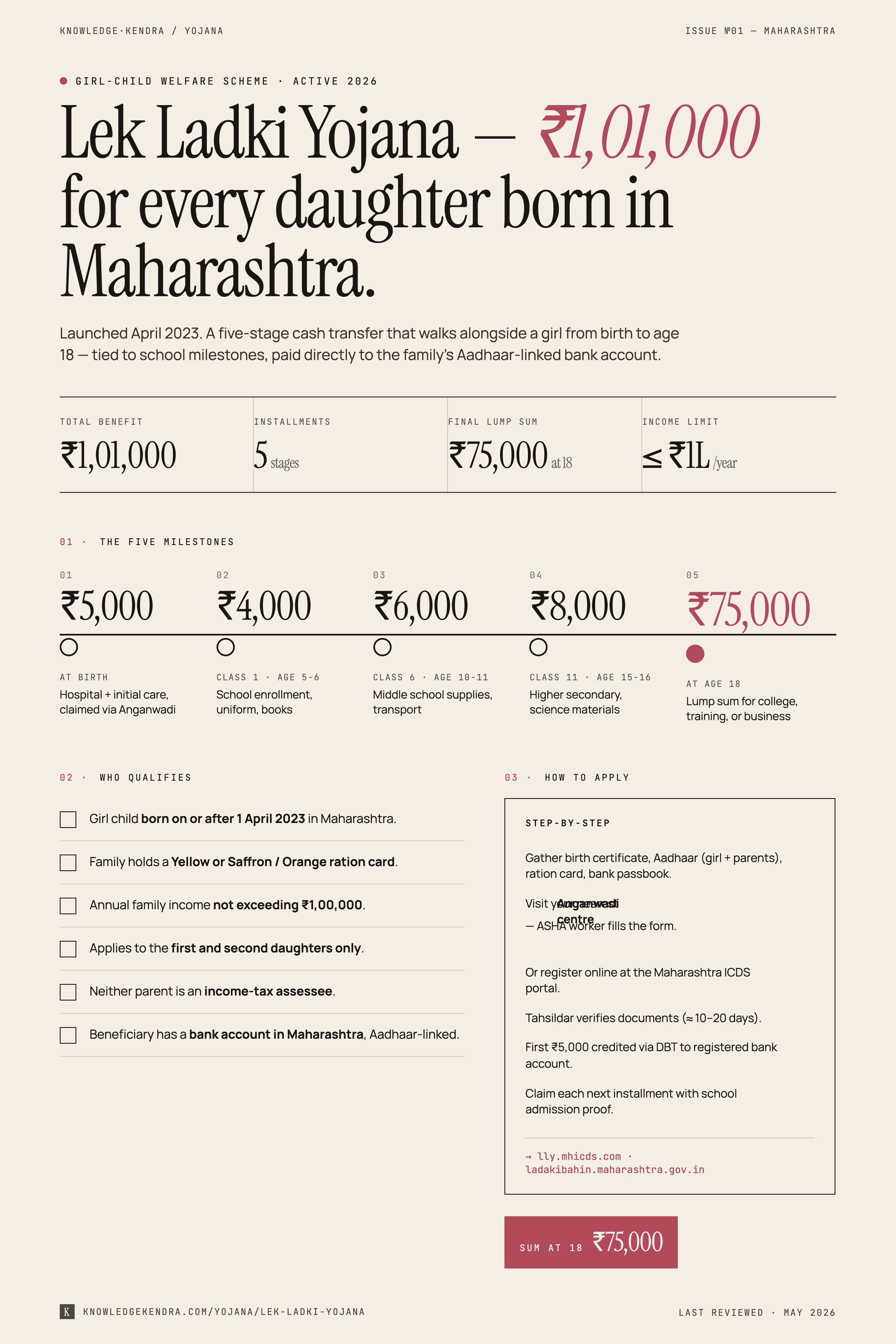
Share this infographic
📌 You might also need
Growing the Money Set Aside for Her
Scheme payouts for a daughter work best alongside a long-term deposit. Compare the options.
More Maharashtra Schemes
Schemes for Maharashtra residents you may also qualify for.
🛠️Payment failed or stuck? It is usually a name mismatchIf your Aadhaar and bank names differ even slightly, DBT credits bounce. Here is the exact fix, step by step
❓Frequently Asked Questions
Maharashtra Lek Ladki Yojana Portal
lly.mhicds.com
🔗Related Schemes
📋 Official Sources & Verification
Information verified against official government portals and gazette notifications. Read our editorial process.

Researched & verified from official sources
Last reviewed
May 2026
May 2026