On This Page
Bank PO vs SSC CGL vs State PSC 2026: Salary, Career Compared
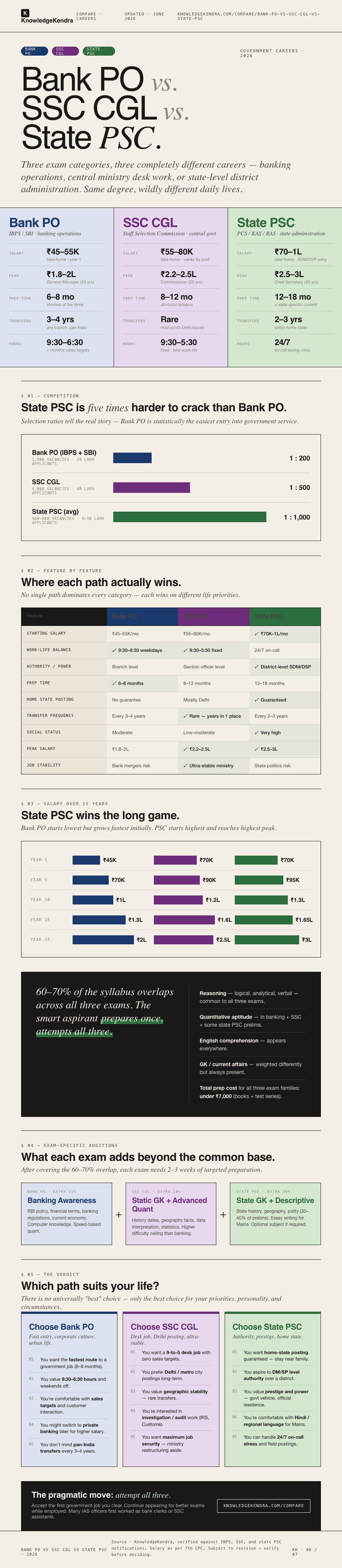
Three most popular government exam categories lead to completely different careers: banking operations, central ministry desk work, or state-level administration. Choose wisely.
📊The Three Career Paths at a Glance
| Feature | Bank PO (IBPS/SBI) | SSC CGL | State PSC (PCS/KAS) |
|---|---|---|---|
| Starting salary (2026) | ₹36K basic + ₹10-15K allowances | ₹44,900 basic + ₹20-30K allowances | ₹56,100 basic + ₹15-20K allowances |
| Effective take-home | ₹45,000-55,000/month | ₹44,900-1,12,400/month | ₹56,100-80,000/month |
| Top post possible | General Manager (Scale VII) | Commissioner (Level 14) | Chief Secretary / Principal Secretary |
| Peak salary (25 years) | ₹150,000-200,000/month | ₹200,000-250,000/month | ₹180,000-250,000/month |
| Work type | Banking operations, loans, branch management, marketing | Desk work, audit, tax, ministry administration | Field administration, law & order, revenue, welfare |
| Transfers | Every 3-4 years, any branch pan-India | Rare (many posts Delhi-based) | Every 2-3 years within state |
| Work hours | 9:30-6:30 + targets | 9:30-5:30 fixed | Unpredictable: 24/7 during crisis |
| Social status | Moderate (respected professional) | Low-Moderate (desk job perception) | Very High (SDM/DSP are powerful) |
| Preparation time | 6-8 months standard | 8-12 months intensive | 12-18 months + state-specific content |
| Exam difficulty | Moderate (quants-heavy) | Moderate-High (all-round) | High (essay, interview, local knowledge) |
| Power/Authority | Limited (bank branch level) | Limited (section officer level) | High (sub-division/district level) |
Bank PO = fastest career growth, urban postings. SSC CGL = desk job, work-life balance. State PSC = highest prestige and authority, home state postings.
Selection Difficulty: State PSC is 5x Harder Than Bank PO
🏦Career Path 1: Bank PO (Probationary Officer)
Bank PO exams are conducted by IBPS (Institute of Banking Personnel Selection) and SBI (State Bank of India). IBPS PO recruits 1000+ officers annually across 20+ banks.
SBI PO recruits 500+ directly into SBI. Combined, it's the easiest and fastest route to government employment.
Salary & Benefits: Starting at ₹36,000 basic + allowances (HRA, DA, transport) totaling ₹45-55K/month. After 5 years, expect ₹60-80K/month.
After 15 years as DM (Deputy Manager), ₹100K+. Promotions happen on fixed time-scales (every 3-4 years).
Pension: 50% of average salary for life + family pension.
Day-to-Day Work: Branch management, overseeing tellers, approving loans, managing customer relationships, meeting daily deposit targets. You're a middle-manager handling 30-50 staff and 10,000+ customers per branch.
Zero desk work: constant field interaction.
Work-Life Balance: Strict 9:30-6:30 with weekends off. However, target pressure is real (every month you have lending/deposit/insurance targets).
Salary premiums/bonuses depend on branch performance. Rural postings can be stressful (limited social amenities).
Growth Path: Scale I (PO) → Scale II (SO) → Scale III (Manager) → Scale IV → Scale VII (GM). Max post is General Manager.
However, scale IV onwards requires lateral movement into specialized roles (IT, HR, Risk). Pure branch managers rarely reach beyond Scale IV.
Transfers: Every 3-4 years, you're transferred to a different branch. Could be promotion posting (metro cities) or punishment posting (rural).
After 10 years, you can request stable posting. Limited inter-bank mobility: you're mostly stuck in your bank unless you quit.
📑Career Path 2: SSC CGL (Combined Graduate Level)
SSC CGL recruits for Group B and Group C posts across central government departments (CBIC, CBDT, CAG, central ministries). Salary range Rs 55-80K, mostly Delhi-based postings, work-life balance is best among the three options. Selection ratio 1:500.
SSC CGL: Honest Pros and Cons
🎯Who Should Choose SSC CGL
SSC CGL is ideal if you want: (1) stable 9-to-5 government job with no field duties or transfers, (2) Delhi posting (good for spouse jobs, children's schooling), (3) low-stress environment compared to bank or PSC, (4) moderate prep time of 8-12 months.
Avoid SSC CGL if: you want fast career growth (slow promotion ladder), want home state posting (mostly Delhi), or have high salary aspirations (caps around Rs 1.5L even at senior level). Many candidates view SSC CGL as the 'safe' choice - a comfortable government job without the demanding lifestyle of bank/PSC. It is also the most common path for candidates who clear it on first attempt (better selection ratio than State PSC).
🏛️Career Path 3: State PSC (PCS/KAS/RAS)
State Public Service Commissions recruit for state government positions like SDM, DSP, BDO, Deputy Collector. Salary tops the three paths (Rs 70K-1L start) and authority is unmatched - you administer districts of millions of citizens. However, selection is also hardest (1:1,000).
State PSC: Realistic Pros and Cons
🎯Who Should Choose State PSC
State PSC is the right choice if you value: (1) home state posting guaranteed - you live near family, (2) maximum authority and prestige - DSP and SDM roles command immediate respect, (3) regional language strength - Mains writing in regional language is an advantage for native speakers, (4) long-term career ceiling - reaching Chief Secretary equivalent in 25 years matches what UPSC IAS achieves.
Avoid State PSC if: you cannot commit to 12-18 months of intensive prep, you want quick joining (process takes 18-24 months), or you have minimal regional language skills (compulsory papers cause attrition). Many candidates start with Bank PO at age 25, attempt State PSC at 28-30 with age relaxation, succeed by 32. This staircase approach often produces better outcomes than direct State PSC attempts at age 23.
Starting Salary at Year 1 (in Rs)
💰Salary Progression: 25-Year Comparison
| Career Stage | Bank PO | SSC CGL | State PSC |
|---|---|---|---|
| Year 1 (Starting) | ₹45K | ₹70K (average) | ₹70K |
| Year 5 (After 1-2 promotions) | ₹70K | ₹90K | ₹95K |
| Year 10 (Senior Officer) | ₹100K | ₹120K | ₹130K |
| Year 15 (Manager/Senior Officer) | ₹130K | ₹160K | ₹165K |
| Year 20 (AGM/Joint Director) | ₹160K | ₹200K | ₹190K |
| Year 25 (DM/Commissioner/Principal Secretary) | ₹180K-200K | ₹220K-250K | ₹220K-250K |
Should You Attempt All Three Exams?
- Graduate from any stream (most posts accept)
- Aged 21-32 (Bank PO/SSC) or 21-42 (State PSC)
- Can commit 6-18 months serious prep
- Comfortable with English (Bank PO) or Hindi (State PSC)
- Willing to relocate anywhere in India (Bank PO/SSC)
- 60-70% syllabus overlap means prep once, attempt all three
- Above upper age limit for your category
- Not graduated by the application year
- Cannot commit to consistent multi-month prep
- Looking for immediate joining (process: 12-18 months)
- Want only private sector career growth
- Cannot handle pan-India transfer (Bank PO/SSC roles)
State PSC officers reach ₹2.5-3 lakh/month at career peak: the highest among all three paths. But they work 12-14 hour days and field postings can be challenging.
Syllabus overlap across all three exams
Reasoning (logical, analytical, verbal) is common to all three. Quantitative aptitude appears in Bank PO + SSC + some State PSC prelims. English comprehension appears everywhere. GK and current affairs are weighted differently but always present. The smart strategy: prepare once, attempt all three. Total prep cost under Rs 7,000 (books + test series).
🎯Decision Matrix: Which Path is Best for You?
| If You Value | Best Choice | Why |
|---|---|---|
| Fastest entry into government | Bank PO | 6-8 months prep. Easier exam. Immediate hiring after selection. |
| Highest starting salary | State PSC | ₹70K from day 1 (vs ₹45K for bank PO, ₹70K for CGL). |
| Staying in your home state | State PSC | Transfers within state guaranteed. Bank PO = all-India. SSC = Delhi-heavy. |
| Work-life balance | Bank PO | Strict 9:30-6:30. No on-call duty. Weekends off. SSC = desk grind. PSC = 24/7. |
| Least preparation time | Bank PO | 6-8 months. SSC needs 8-12. PSC needs 12-18 months. |
| Real power & authority | State PSC | SDM/DSP handle district. Bank PO = branch level. SSC = ministry level. |
| Job security (stable) | SSC CGL | Government ministry = ultra-stable. Bank mergers/technology can disrupt PO. PSC affected by state politics. |
| Peak earning potential | SSC CGL or PSC | ₹220-250K at top. Bank PO caps at ₹180-200K. |
| Least transfer frequency | SSC CGL | Delhi postings = 20 years one place. Bank every 3-4 yrs. PSC every 2-3 yrs. |
| Best post-retirement income | State PSC | Chief Secretary status = board directorships, consulting. High respect. |
⚖️Honest Assessment: Pros and Cons
BANK PO ADVANTAGES: Easiest to crack (6-8 months prep), fastest entry (exams every 6 months), best work-life balance (9:30-6:30, weekends), direct responsibility (branch manager = leadership experience), better salary progression initially (₹45K → ₹130K in 15 years).
BANK PO DISADVANTAGES: Capped growth (rare to reach beyond Scale IV), transfer nightmare (every 3-4 years), target pressure is mentally exhausting, private sector offers same salary with better hours, professional growth limited to banking domain.
SSC CGL ADVANTAGES: Highest peak salary (₹220-250K possible), most stable ministry posting, access to specialized cadres (IRS, Customs very prestigious), pan-India network, best for those wanting 'desk job' safety.
SSC CGL DISADVANTAGES: Extremely competitive (4M+ candidates vs 4K jobs), Delhi-centric (60% posts), desk work is repetitive, least authority (section officer level), political interference high, zero work-life balance in certain cadres (IT/Customs/Police).
STATE PSC ADVANTAGES: Highest starting salary, real district-level power (SDM/DSP are powerful), stays in home state, fastest to senior positions (Chief Secretary by 55), very high social status, best retirement income potential.
STATE PSC DISADVANTAGES: Most stressful job (24/7, law & order crisis), longest preparation (12-18 months), physically/mentally demanding (especially DSP role), transfers every 2-3 years (though within state), state politics can derail career, highly dangerous in certain postings.
📚Preparation Roadmap and Success Rates (2026)
| Exam | Total Candidates | Total Vacancies | Success Rate (%) | Preparation Months |
|---|---|---|---|---|
| IBPS PO | 1500000 | 1000 | 0.067% | 6-8 |
| SBI PO | 500000 | 500 | 0.1% | 6-8 |
| SSC CGL (Tier I+II) | 4000000 | 4000 | 0.1% | 8-12 |
| State PSC (BPSC) | 800000 | 500 | 0.06% | 12-18 |
| State PSC (MPPSC) | 900000 | 400 | 0.04% | 12-18 |
| State PSC (TNPSC) | 600000 | 600 | 0.1% | 12-18 |
Recommended Exam Attempt Sequence (Year 1)
📈Career path comparison: 15-year trajectory
Bank PO → 15 years → Chief Manager/AGM: Salary Rs 1,20,000-1,80,000/month. Managing regional branch clusters or heading specialized departments (credit, forex). Corporate environment with performance reviews and targets. International posting opportunities at overseas branches.
SSC CGL Inspector → 15 years → ITO (Income Tax Officer): Salary Rs 85,000-1,15,000/month. Group A officer conducting assessments, investigations, and enforcement.
Investigative and analytical work: reviewing financial statements, questioning taxpayers. Seniority-based promotions with departmental exam for ITO level.
State PCS → 15 years → ADM/DM: Salary Rs 1,00,000-1,40,000/month plus government bungalow, vehicle with driver, domestic help. Administering law and order for millions of people.
The prestige and lifestyle: government vehicle with beacon, official residence, district authority: are unmatched by any other career at the same age level.
The lifestyle reality: Bank AGM drives his own car to office. SSC ITO uses government transport for raids and assessments. State PCS DM has a government Ambassador/Innova with red beacon and driver. Same education level, same starting age: completely different daily lives.
📚Preparation overlap: study once, attempt all three
60-70% common syllabus: Reasoning (logical, analytical, verbal) is in ALL three. Quantitative aptitude is in banking + SSC (and some state PSC Prelims). English comprehension is everywhere. General knowledge and current affairs appear in all exams. One preparation base serves three exam families.
Additional 15-20% per exam: Banking: add banking awareness, financial awareness, computer knowledge. SSC CGL: add advanced quant (data interpretation, statistics) and static GK (history dates, geography facts).
State PSC: add state-specific GK (30-40% of Prelims), descriptive writing for Mains, and Optional subject if required.
Annual exam calendar: January-March → common preparation (Reasoning, Quant, English, GK). April-June → SSC CGL + IBPS PO Prelims. July-September → State PSC Prelims. October-December → Mains for cleared exams. Three major exams per year = triple selection probability.
Total preparation cost: 3 test series (banking + SSC + state PSC) at Rs 500-1,500 each = Rs 1,500-4,500. RS Aggarwal for Reasoning + Quant. Lucent GK. State-specific GK book. Arihant Banking Awareness. Total books: Rs 1,500-2,000. Full preparation for all three exam families: under Rs 7,000.
Typical Career Trajectory (Combined Outlook)
🎯Which suits YOUR personality
Choose Bank PO if: You enjoy customer interaction and financial problem-solving. You're comfortable with sales targets. You want corporate-style merit-based promotions. You don't mind transfers every 3-5 years. You might consider moving to private banking later for higher salary.
Choose SSC CGL if: You want 9-to-5 desk job with no sales targets. You prefer Delhi/metro city postings. You value work-life balance over salary maximization. You're interested in investigation/audit work. You want geographic stability: CGL posts rarely transfer outside assigned zone.
Choose State PSC if: You want home-state posting guaranteed. You aspire to DM/SP level authority (achievable in 15-20 years). You're comfortable with Hindi/regional language for Mains. You value prestige and power: government vehicle, official residence, district authority.
Choose ALL THREE if: You're pragmatic and want maximum probability of government career. The preparation overlap is 60-70%: targeting three exams costs only 30% more effort than targeting one.
The aspirant who appears for 3 exams and clears 1 gets a career. The aspirant who targets only 1 and fails gets nothing.
💰Starting salary and total compensation comparison
Bank PO: Rs 52,000-62,000/month cash + concessional loans (home loan 2% below market = Rs 3,000-5,000/month saving) + free banking services. No government accommodation. Total effective compensation: Rs 57,000-67,000.
SSC CGL Inspector: Rs 55,000-70,000/month cash (top posts like Income Tax Inspector at Pay Level 7). CGHS medical coverage (saves Rs 5,000-10,000/month on health expenses).
Government accommodation in some cities (saves Rs 8,000-15,000/month). Total effective: Rs 65,000-90,000 for Inspector-level posts.
State PCS SDM: Rs 50,000-65,000/month cash. Government bungalow (market rent value Rs 15,000-30,000/month).
Government vehicle with driver (value Rs 10,000-15,000/month). Domestic help allowance.
Medical coverage. Total effective: Rs 85,000-1,10,000.
Lowest cash salary but highest total compensation when non-monetary benefits are included.
At the 10-year mark: Bank Senior Manager Rs 1,00,000-1,30,000 (cash-heavy). SSC Section Officer Rs 75,000-95,000 (balanced). State PCS DC/SP Rs 1,50,000-2,00,000 (benefit-heavy: bungalow, vehicle, staff). State PCS wins on total compensation at every career stage beyond year 5.
What Each Exam Tests Beyond the 60-70% Overlap
⚖️Work-Life Balance: Honest Daily Comparison
Each career has distinct daily rhythms. Beyond salary numbers, your daily quality of life will differ dramatically across these three paths. Honest comparison of what a typical workday looks like:
Daily Work Reality Compared
🗓️What This Looks Like Daily
Bank PO typical day: Arrive at 9-9:30 AM, attend morning briefing on daily sales targets, handle customer transactions and loan processing until lunch, sales push and follow-ups in afternoon, daily closing report by 6-6:30 PM. Weekends include 1-2 Saturdays of work. Customer-facing role brings constant interpersonal interaction and sales pressure.
SSC CGL ASO/Inspector day: Fixed timings 9:30 to 5:30 PM, file processing and report preparation, government office culture (slower pace), weekends always off, 30+ annual leaves. Trade-off: limited career growth and less authority compared to PSC officers.
State PSC officer day: Highly variable. Some weeks calm (8 AM start, 6 PM end, evening relaxation), other weeks chaotic (election duty, disaster management, VIP visits). Phones never truly off. The authority and impact are unmatched but personal time is unpredictable.
📅Exam Timeline and Attempt Planning
Three government exam families run on different annual cycles. Smart aspirants align prep timelines to maximize attempts per year. Here is when each exam typically happens:
Typical Annual Exam Calendar (Triple Strategy)
🎯Attempt Strategy
Year 1 strategy: Bank PO is your best bet because it has the lowest selection ratio (1:200) and accepts younger candidates. Even clearing one Bank PO exam in Year 1 gives you a salary while you continue preparing for SSC and State PSC in Years 2-3.
Critical timing rule: never skip a notification because you feel unprepared. Each attempt gives you exam-room experience that mock tests cannot simulate. Even attempting at 60% preparation level often clears Prelims, exposing you to actual Mains and Interview rounds. By Year 3, this exposure compounded across multiple notifications becomes your competitive edge over single-exam-focused aspirants.
📚Resources for Triple-Exam Preparation
Preparing simultaneously for Bank PO, SSC CGL, and State PSC requires careful resource selection because 60-70% syllabus overlaps. The right strategy: invest in shared resources first, then specialized ones.
Resources by Category (Under Rs 7,000 Total)
⏰Time and Money Allocation
Successful triple-exam aspirants follow the 70-20-10 rule: 70% time on shared topics (Quant, Reasoning, English, basic GK), 20% on exam-specific content (Banking Awareness, State GK, Static GK), 10% on test analysis and revision. This compounds efficiency: a single Quant question practiced helps all three exams.
Money-saving tip: many coaching institutes' YouTube channels offer free quality content (Adda247, BYJU's Exam Prep, Unacademy Free). Mock tests are the only paid resource truly worth it. A Rs 2,500 annual test series across all three exam families pays back through better exam temperament. Avoid expensive offline coaching unless you struggle with self-discipline - online prep at Rs 7,000 matches Rs 50,000 offline coaching for motivated candidates.
Total prep cost for all three exams
Books + test series for the full triple-exam preparation costs under Rs 7,000. Compare this to private coaching that runs Rs 50,000-2,00,000 per exam. The pragmatic move: attempt the first government job you clear, continue appearing for better exams while employed. Many IAS officers first worked as bank clerks or SSC assistants.
❓Frequently Asked Questions
📋 Official Sources & Verification
Information verified against official government portals and gazette notifications. Read our editorial process.

May 2026